Lolling about and playing with photoshop

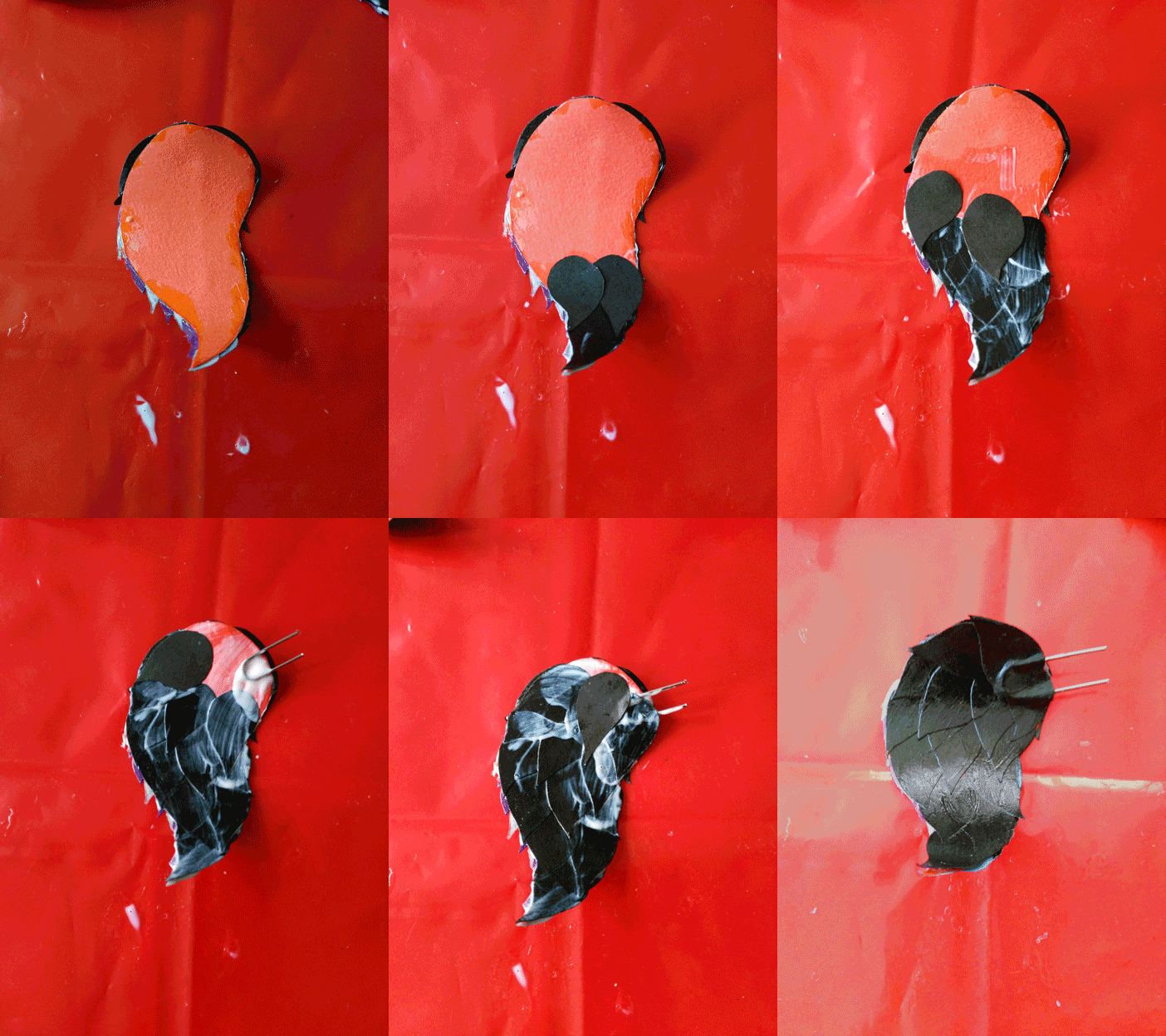
I’ve not been very well so instead of doing a bunch of important things including working out some of my tax bits and pieces I’ve been lolling about on the sofa watching the telly and playing with glue, and teaching myself how to make a gif on photoshop. Here’s my efforts (it works! Yey to ill me) – it’s the underside of a magpie wing I’ve been making for Christmas decorations (if you are interested, I’ve put together a materials list here of the stuff I’ve been using lately).

magpie-wing

Re-blog: Building creative confidence

I’m not feeling well this weekend and so am mostly lounging about in my pyjamas in front of the telly and making chicken noodle soup. I did want to share this from the Adonis Diaries blog – it’s the transcript of a TED talk given by David Kelly about building creative confidence. It’s good stuff, go over there and have a read, or watch the talk.

Do you know how to build your creative confidence? In what again? I wanted to talk to you today about creative confidence. I’m going to start way back in the third grade at Oakdale School in Barberton, Ohio. 00:21 I remember one day my best friend Brian was working on a project. He was making […]

via Do you know how to build your creative confidence? In what again? — Adonis Diaries

Don’t for a minute think about stopping you lovely bunch of creatives

p1000345

[EDIT: So I had a nice formal sounding title for this post, but then I went and changed it because this feels better in getting across what I want to say]

I was procrastinating before work this morning and read this article from George Monbiot on the Guardian website about neoliberalism and loneliness and mental health. I thought it was an interesting article and feel he has a number of valid points about how the two things are connected. I was particularly interested in the scientific work he referenced about the link between stress, pain and physical contact. Anyway it’s a good article – I’m not going to re-write what he says here – go check it out for yourself.

The article this morning happened to come to my attention just two days after I had stumbled onto the work of Prof. Paul Crawford from the University of Nottingham after I me him during a day job event. Paul has been suggesting some really interesting ideas about how we enable people to use arts, humanities and creativity in looking after their own mental health and in their recovery from mental illness. He has a particularly interesting ideas around some form of collective healing through arts and humanities. He’s recently published a book called Health Humanities on the subject with Brian Brown, Charley Baker, Victoria Tischler and Brian Abrams. I’ve not read it yet but I’ve downloaded it and will be putting it on the list.

Both Crawford’s talk and Monbiot’s article have lead me to thinking a bit more about our culture and the role of arts in it. I feel over the last decade and probably for longer there has been this odd political positioning of people who are ‘Artists’ who get to do the making of things, and the rest of us as consumers, who are consumers who are meant to buy things. And things have become very easy, and very cheep to buy. This feels like quite a different situation to the one my parents and grandparents grew up in. My grandfather would probably not have called himself an artist, but he could make anything, and it was common for people to make things for each other, like jam. I like jam.

When I was younger I think I had quite a dismissive attitude towards people who made things (unless they were one of those special, magical, serious people, a proper artist), especially people who made things in groups or clubs. I was a child of the 80s, and while I grew up in the countryside without much stuff, the prevailing political climate was one of stuff worship (and not hand made stuff either). I’ve completely changed my mind about this. For people to gather together to share their making, like a meal, or to make things together, like kitting or music, or in staging a play, is a profoundly creative act. To be connected to each other through our creativity is a profoundly human one.

I think there is a backlash towards this at the moment, and it is thrilling. The internet used to be full of cats. Now it is full up of people having a go at being artists. And crafters and cooks and gardeners and poets. And people making Jam. It is full of artists cheering on other artists. A community or creatives supporting other creatives. Brilliant. Don’t for a minute think about stopping you lovely bunch of creatives.
A bit more on ‘On not being able to paint’

I’ve been digging into Marion Milner’s book ‘On not being able to paint’ and have been really enjoying this. The book describes Milner’s efforts in trying to learn how to paint, and she takes a psychoanalytic perspective on this. I’m no expert in psychoanalysis and have definitely had to re-read a few bits and pieces to get a better appreciation of their meaning. Even so I have been enjoying the book as an interesting and thoughtful meditation on the creative process and what that can mean for the creative individual. This week I’ve been particularly struck by this quote:

“It now looked as if some of the spiritual dangers to be faced in this matter of coming to see as the painter sees were concerned with the transfiguration of the external world; in fact with a process of giving to it something that came from within oneself, either in an over whelming of a reviving flood. Also this process could be felt as a plunge – a plunge that one could sometimes do deliberately, but which also sometimes just happened, as when one falls in love.”

Last week I struggled to even begin to describe the quality of the light that was created through the stained glass windows of La Sagrada Familia. I think also I was  in complete awe of the sheer scale of that creative effort. I think in part this came from knowing the personal, internal effort that would have been involved in committing the vision of something on that scale to paper, and to see it built, and the vulnerability that would require. This is possibly why this quote has spoken to me this week.

Cool artsy stuff with Jade Herriman

dscn1250

A few weeks ago I came across the blog of Jade Herriman. It looked like she was doing something interesting but it wasn’t until this morning that I had time to take a bit of a dive into her blog to see what was going on.

I really like her site. Jade is based in Australia and has set up an arts and mental health based business. The talented lady is also an arts therapist and a life coach. I particularly like a series of blog posts she has written about the effort and struggles it takes to set up a successful business, for example this one here.

Last week I wrote a bit about how, among other things, I’m not very comfortable with the current trend of calling colouring books or origami books therapy. They may feel therapeutic, but they aren’t what you would get from a skilled therapist. Turns out Jade has some similar thoughts, and can speak to this from the point of view of a professional.

Anyway, I really like what she’s trying to do, so go check her out.

Gaudi Binge

img_20160928_181541

I’ve just got home after a week in Barcelona. Earlier in the week I wrote about how the city feels like a place where art is part of the everyday life, and have been reflecting a bit on what that may mean. One of the main reasons I wanted to go to Barcelona was that I am particularly taken with art nouveau and that the city is famous for the work of Antoni Gaudi, a major contributor to the movement. I’m particularly drawn to his work as he used the traditional Catalonian skills and methods to create a new, radical, kind of building aesthetic.

I’m a big fan of making time to feed your creativity, in particular by immersing yourself for a few hours in the work of other creatives. I think it’s important to get a sense of what your creative influences are, as this helps you to find your creative community. We spent most of our trip visiting the buildings that were designed and built by Gaudi and the crafts men he worked with. On the Magpie Gaudi hit-list were:

  • Palua Guell
  • La Sagrada Familia
  • Parc Guell
  • Casa Batllo
  • La Pedrera

Because of the rather brilliant organisational skills of my boyfriend we managed to see all of them (woop). Gaudi’s work is thrilling. In the more mature works he almost completely abandon’s the straight line and the the right angle. Some of the buildings do not look so much like they were built, but that they were somehow grown. He had a quite magical understanding of light, and used light wells, glass roofing and stained glass to illuminate interior rooms. He is completely unafraid of using bright colour on the smooth fluid surfaces. I was particularly taken by his use of bold ceramics (both solid, purpose made tiles, and shards of broken pottery and glass) in the elaborate decorative elements on the older buildings and in the monumental sweeping terrace he created at Parc Guell.

I didn’t actually take many photographs of his work while away. The works have been photographed again and again, and frankly any photograph I took just didn’t do credit to the scale and intricacy of the works. On of the photos I did take (above) is a photo of one of the iron doors at La Sagrada Familia. I found our visit to La Sagrada Familia to be particularly affecting and inspirational. The work is an enormous religious shrine, and at the time of writing is still incomplete. Work continues on it to this day. Inside the building is constructed of an elaborate arrangement of slender columns, and the outer skin on the building is littered with huge multicoloured stained glass windows. The scale of the building is breathtaking. The work is an enormous act of creative devotion. As you walk inside the building you are bathed in multi-coloured light. Over the week I’ve tried to think about how it is possible to explain the experience, but I cannot find a way to describe the sheer quality of the light. I think this is only something that can be experienced in person.

On not being able to paint by Marion Milner

I’ve just begun to read ‘On not being able to paint’ by Marion Milner and I really liked the following quote from the page 6 of the first chapter. Marion Milner writes about her struggles in trying to learn how to paint, and relates these struggles to psychoanalytic processes. I think many of us who have an artistic practice will recognise experiences that resonate with this account:

On reaching home I had begun a sketch in charcoal, feeling that the mood to be expressed was a real aesthetic pleasure in beauty of the form, to be embodied in a serious drawing of artistic worth. Instead, figure 2 [a simple drawing of a relatively dour looking lady] appeared.

The book goes on to detail her ongoing artistic development and her use of free drawings to explore internal states of being. Of particular interest to those of you with an interest in art and psychology may be her attempt to paint as an expression of emotion, rather than trying to re-create the image in front of her.

This quote above reminded me of the importance of the ‘practice’ in artistic practice. In ‘practices’ such as yoga or meditation it is readily accepted that when you start, you will find things difficult, but through practice you begin to find things a bit easier, a bit more enjoyable and a bit more useful. I sometime feel that there is something about the idea of being an ‘artist’ which is off putting for people, it doesn’t encourage the idea of practice unless their is a pr-existing ‘talent’. There is sometimes a feeling that you can only really be artistic if every piece of work you create is good, as if only certain people can be artists. I’ve met many people who don’t engage in creative practices because they feel that they are ‘no good’ at making things or drawing things and so they effectively gave up, which I think is really sad.

I think some of the best creative experiences may not result in a beautiful product, or even a finished product. I’d like to believe that the act of being creative in itself is a really positive thing, and that over time and repeated efforts everyone can get better at what ever their chosen creative ‘thing’ is. These are the experiences that can be the most playful and the most experimental, and can lead to the most new learning. Each time you try something new, or delve back into the techniques that you know you enjoy, you build on the things and skills you learned last time. This is what practice is all about.


On finishing things, or, I made a thing, eep!

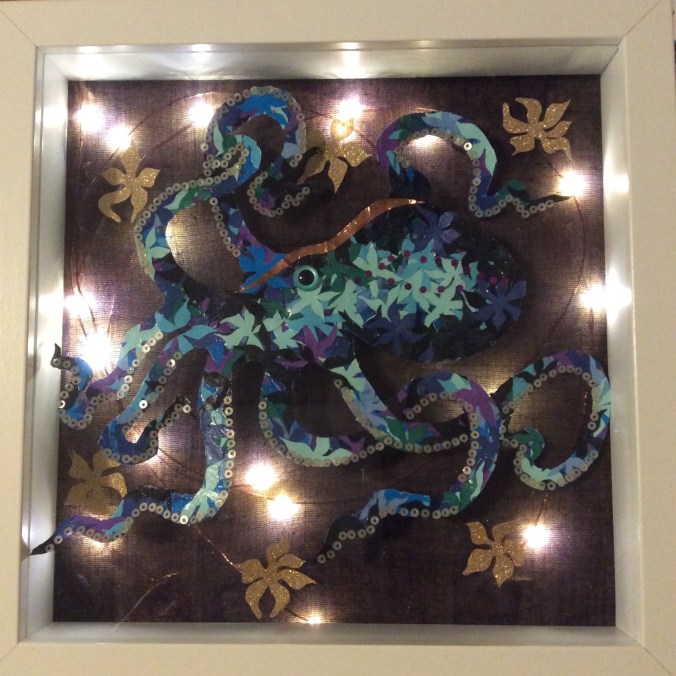
When I started writing blog posts about the connection between creativity and mental wellbeing I initially thought that I would write one, let it loose, see how it flew. Then I had an idea for another one, but I thought I would run out of steam on this thought stream pretty quickly, but then had another idea, and then another. So far each little thought seems to lead to another little thought, that is just enough of an idea to write a blog post about. Go figure.img_0101

Most of the things I blog about in this ‘series’ are just my ideas about theories that I know of and that I find useful in making sense of myself, and of my experiences. If working as a researcher in psychology and medicine and mental health for the last 12 years has taught me anything it is this: there are many splendid varieties of ‘human’. What works for one person will not work for the next, or will work but in combination with a third thing. For many people it is possible to manage their wellbeing through a healthy diet, a decent amount of exercise and a little enjoyable down time. It doesn’t seem to be quite enough for me, there needs to be something….else.

One of my blocks over the last few years has been in finishing things. I don’t know if this is a typical ‘scanner problem’ but I am pretty good at getting dug into a project, and then, about half way through there seems to be another project that I need to start, so I do. And then another. And another. The banner picture on my blog at the moment is a blanket I made for my sister. It took a whopping 7 years to finish that baby off. 7 years. And I was so proud of it that I took pictures of it before I handed it over to use on the banner of this blog. So in contrast to that, this little guy in the picture above only took around six months. And look, he lights up…

img_0100

Many of my ongoing projects are quite ambitious, there is a play, a film and a novel, and now a book about art and wellbeing. I’ve struggled to get close to finishing any of these things and this was beginning to cause lots of creative angst. One of the strategies I’ve come across in the mental health world, and in the online world of inspirational businesses, is the idea of goal setting. Of particular use to me has been setting smaller goals, by which I mean developing much smaller projects that are I could potentially finish in a few weeks (it still takes a few months but never mind). I’m finding that in actually finishing some things I feel much more motivated to return to those more ambitious, difficult projects, and I feel better for it. It’s helping, that the play is actually looking in good shape to send somewhere soon.