On not being able to paint by Marion Milner

I’ve just begun to read ‘On not being able to paint’ by Marion Milner and I really liked the following quote from the page 6 of the first chapter. Marion Milner writes about her struggles in trying to learn how to paint, and relates these struggles to psychoanalytic processes. I think many of us who have an artistic practice will recognise experiences that resonate with this account:

On reaching home I had begun a sketch in charcoal, feeling that the mood to be expressed was a real aesthetic pleasure in beauty of the form, to be embodied in a serious drawing of artistic worth. Instead, figure 2 [a simple drawing of a relatively dour looking lady] appeared.

The book goes on to detail her ongoing artistic development and her use of free drawings to explore internal states of being. Of particular interest to those of you with an interest in art and psychology may be her attempt to paint as an expression of emotion, rather than trying to re-create the image in front of her.

This quote above reminded me of the importance of the ‘practice’ in artistic practice. In ‘practices’ such as yoga or meditation it is readily accepted that when you start, you will find things difficult, but through practice you begin to find things a bit easier, a bit more enjoyable and a bit more useful. I sometime feel that there is something about the idea of being an ‘artist’ which is off putting for people, it doesn’t encourage the idea of practice unless their is a pr-existing ‘talent’. There is sometimes a feeling that you can only really be artistic if every piece of work you create is good, as if only certain people can be artists. I’ve met many people who don’t engage in creative practices because they feel that they are ‘no good’ at making things or drawing things and so they effectively gave up, which I think is really sad.

I think some of the best creative experiences may not result in a beautiful product, or even a finished product. I’d like to believe that the act of being creative in itself is a really positive thing, and that over time and repeated efforts everyone can get better at what ever their chosen creative ‘thing’ is. These are the experiences that can be the most playful and the most experimental, and can lead to the most new learning. Each time you try something new, or delve back into the techniques that you know you enjoy, you build on the things and skills you learned last time. This is what practice is all about.


Thrive by Arianna Huffington: Quick review


This week I finished reading ‘Thrive: The Third Metric of Success’ by Arianna Huffington. I’d been interested in reading it for a while as I’m a bit intrigued by the recent explosion of books about well being by all sorts of high profile people. I’ve got to say I was surprised by this book. I had been aware of the criticism about the book that labelled it as coming from an overly privilaged view point and so being essentially difficult for anyone from less socio-economically successful environments to put into practice. I think some of that criticism is still legitimate, but I was expecting something that would advocate pricey massages and other expensive relaxation strategies. That is not what I got.

First, the book is well researched and draws on learning from science and philosophy. This made it an enjoyable and interesting read. Second, Huffington advocates a new conceptualisation of success that involves building small amounts of time into your life for a focus on your own wellbeing, and wisdom, and for taking time out to gaze in wonder at the everyday beauty of the world we live in. She doesn’t advocate expensive treatments or miracle diets or anything like that. Instead she talks about strategies such as meditation, walking, sleeping well, connecting with friends and family, and giving time in voluntary service. All of these strategies don’t cost any money. What they do cost is time. It can be very difficult for the average working person to find parcels of time in the day to day run of things to do all of these things that we all know we should be doing, and this is not something that the book was particularly helpful with. Still, I enjoyed reading the book and learned a few new things too.

On finishing things, or, I made a thing, eep!

When I started writing blog posts about the connection between creativity and mental wellbeing I initially thought that I would write one, let it loose, see how it flew. Then I had an idea for another one, but I thought I would run out of steam on this thought stream pretty quickly, but then had another idea, and then another. So far each little thought seems to lead to another little thought, that is just enough of an idea to write a blog post about. Go figure.img_0101

Most of the things I blog about in this ‘series’ are just my ideas about theories that I know of and that I find useful in making sense of myself, and of my experiences. If working as a researcher in psychology and medicine and mental health for the last 12 years has taught me anything it is this: there are many splendid varieties of ‘human’. What works for one person will not work for the next, or will work but in combination with a third thing. For many people it is possible to manage their wellbeing through a healthy diet, a decent amount of exercise and a little enjoyable down time. It doesn’t seem to be quite enough for me, there needs to be something….else.

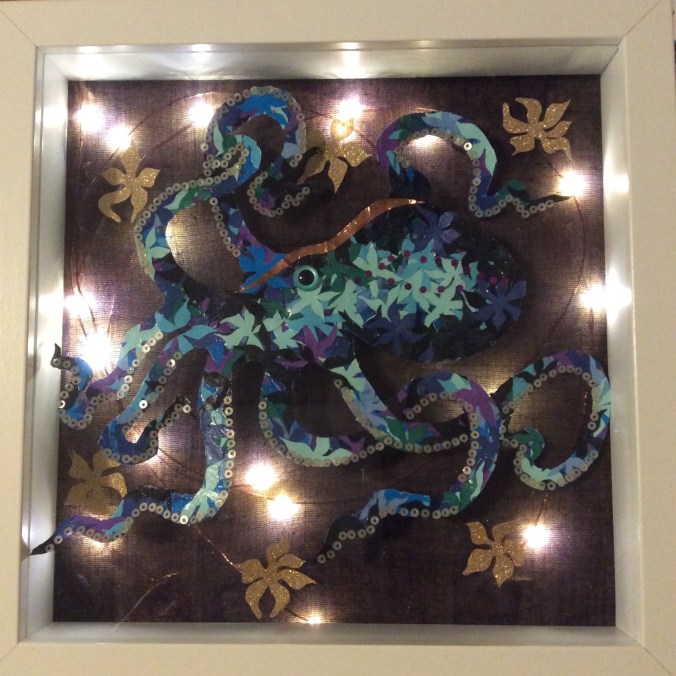
One of my blocks over the last few years has been in finishing things. I don’t know if this is a typical ‘scanner problem’ but I am pretty good at getting dug into a project, and then, about half way through there seems to be another project that I need to start, so I do. And then another. And another. The banner picture on my blog at the moment is a blanket I made for my sister. It took a whopping 7 years to finish that baby off. 7 years. And I was so proud of it that I took pictures of it before I handed it over to use on the banner of this blog. So in contrast to that, this little guy in the picture above only took around six months. And look, he lights up…

img_0100

Many of my ongoing projects are quite ambitious, there is a play, a film and a novel, and now a book about art and wellbeing. I’ve struggled to get close to finishing any of these things and this was beginning to cause lots of creative angst. One of the strategies I’ve come across in the mental health world, and in the online world of inspirational businesses, is the idea of goal setting. Of particular use to me has been setting smaller goals, by which I mean developing much smaller projects that are I could potentially finish in a few weeks (it still takes a few months but never mind). I’m finding that in actually finishing some things I feel much more motivated to return to those more ambitious, difficult projects, and I feel better for it. It’s helping, that the play is actually looking in good shape to send somewhere soon.


Creativity and Catharsis

p1000284

I’ve been blogging over the last few weeks about how an arts practice can be a positive thing for wellbeing and mental health. In my last post I was musing on how in the process of making things we transform one set of things (paper and paint, thoughts and feelings) into something else, something beautiful.

I’m interested in the idea that as part of the process of making something, it is possible to use thoughts, feeling, ideas or experiences as a raw material for craft. The concept of artistic expression as a cathartic process is not new. The idea is that the artist may not only use their practice as a medium through which to express feelings, but in the process may somehow expel or ‘purge’ negative emotions from their systems and in doing so would be relieved from them. For many people some negative emotions hold such power that it may be difficult to actually articulate them. A sweep of dark paint across a canvas, or beating of drums or moving the body through dance, may be the way in which a person may actually be able to give some form to those emotions. Once the paint is on the canvas a person may be able to ‘see’ what they are feeling externalised, and feel the emotion is no longer contained within them, but has been ‘set free’. I understand this reading of catharsis as a little like mental vomiting, expelling what is noxious to be rid of it.

A few years ago I was very interested in how story and narrative may have an impact on us humans, and I read the work of (and had the privilege of meeting with) Prof. Keith Oatley, who was very interested in the idea of fictional literature as a kind of emotional simulation. He had a slightly different reading of catharsis that drew on a different translation of the Greek roots. He described how catharsis could be interpreted not as a purging, but as a process of ‘clearing away’ or making sense of emotional turmoil. The experience of being in mental distress can be highly confusing. Some have suggested that through the process of creating art out of an emotional situation, it can be possible to make sense of it. The act of externalising emotion through that sweep of paint on the canvas may not really be effective in removing the emotion from the inside, but what it may be able to do is help make sense of it so that it is ever so slightly easier to live with.

Quick review: Body of work by Pamela Slim

I’ve not blogged this week as I’ve not really been at my best, and have been doing the ‘one thing at a time’ thing this week. I’m not going to do a long piece now should be back tomorrow with something a bit more interesting. I have, however, been enjoying the book Body of Work by Pamela Slim. She’s written a book about what work could mean in what is now a rapidly changing situation. The style of working that involves a job at the same place, in the same career path, for the majority of your career is becoming less common and indeed less possible to sustain. Many more people, through choice or necessity, are developing ‘portfolio careers’ with multiple strands, gigs and projects. I think this can leave some of us feeling a bit disoriented, and unsure exactly how to shape that kind of way of working in a way that may make the most of our varied talents.

I really liked Pamela Slims approach to thinking about this. In the book she makes the argument that over a lifetime we should look to create a Body of Work – so a collection of different projects and occupations that form a substantial contribution to society. I think what I particularly liked about this is how she writes about finding your own narrative. The book has a series of mini projects and exercised throughout the book that are designed to allow you to gain a sense of what your own narrative may be and how to tell that story about your body of work. I think in the past for me this has been a difficulty, I have worked in academic research in a number of areas, and tried to nurture my creative interests outside of that, and everything felt a bit bitty (I’ve recently found out there is a name for people like us, ‘Scanners’). Pamela Slim suggests that everyone should have a ‘Side Hustle’, which is very sensible, but some of us have more ideas for side hustles than time to really work them. I think the idea of working out what you narrative is can really help with that, as it can allow you a framework to work out which projects are worth prioritising, and which ones can wait a little. I am now working much more specifically to attempt to create more space for the creative interests and skill development. I think this book is another step in helping scanners or multipotentialites make sense not only of who we are but also who we can find a way of working that fits more naturally with our way of being. So in sum, I liked it.

Making and mental health: Arts as a transformative practice

img_0076-1I have been musing over the last few weeks in what has turned into a little blog series about how having an arts practice can be a positive thing for mental health. It certainly works on some level for me. Over the last few years I keep coming back to the idea art as a transformative practice in the projects I have started (and often not really finished – I have the multipotentialite problem of too many projects and not enough time). One of the characters in a novel and then in a play I have been (am still) working on was directly concerned with this idea, and I’ve often spoken informally to artists of have had similar thoughts about it.

The act of Making is one of transformation. We take all manner of things, objects, paper, paint and glue and in combining those things through various techniques we transform them into something new and possibly unique. For many artists one of those ingredients is feeling. The act of using good feeling or bad and channelling that into a project to transform into something else is an profoundly creative act. The idea that emotions can feed creative work has been around for a long time, as has the stereotype of the ‘troubled artist’, so I am doubtful that this is a new idea to many reading this. I think it is this ability of an arts practice to allow the expression of feeling that can make it particularly positive. It can be a way of expressing, and gaining clarity, on what is going on for a person without requiring them to directly verbalise it. Potentially for many, expressing themselves through visual means, or through music, makes far greater sense that attempting this through what can be the very limiting medium of words.

I’m not suggesting that all art is about this process, for many art can also be a restful or pleasing diversion. But frequently the art that speaks to me most speaks to me on this level. A really useful way of thinking about this for me came through reading Amanda Palmer’s Book ‘The Art of Asking’ (I really enjoyed this one, more on this another time). There are a lot of useful ideas in here, but the one that grabbed my interest in particular was the idea of the artist as ‘Sin Eater’. Traditionally the Sin Eater was a person who may live at the margins of a community. Their role was to take on the sins of a person who had recently died so that person would be able to pass on to heaven. In Welsh communities the Sin Eater may visit with a family and break bread and drink ale over the body of a loved one to ‘eat’ their sins. In ‘The Art of Asking’ Amanda Palmer speaks about the artist as the sin eater, as a figure who is able to take on the sadness, anger or distress of others and transform that into something beautiful, into art. I found this description particularly useful to think about, and in understanding the function art can play in helping us understand ourselves.

My first re-blog…

I’m pretty new to blogging but one of the blogs I have been following is Craft and Other Crazy plans. She’s suggested we do some re-blogging this morning so here I am – in particular check out her A-Z of crochet – good stuff….

First of all If you reblog this post you help me, I help you and you help your readers, so everyone wins.. There are thousands of good blogs out there and think of all of that we are missing just b… Source: Share your blog!

via Share your blog! — craftandothercrazyplans

Pleasure in working my craft

IMG_1095

I’ve been blogging over the last week or two about how making has been helpful to me when it comes to mental health and managing anxiety. When I first began to contemplate this subject on this blog I drew the link between mindfulness and making, and wrote about how I manage to reach my most mindful state when, well making. I’ve been thinking a bit more about this and while I think in principle this definitely holds, there are ways in which my arts practice diverges significantly from the practice of mindfulness.

In a course I recently completed on mindfulness we were taught to experience things without ascribing value to it, or to become attached to it. The mind has a tendency to attach to things that are pleasurable and to try to prolong that sensation while trying to avoid sensations that are uncomfortable or distressing. One of the ideas behind mindfulness is that the pursuit of pleasure and the attempts to avoid pain are one of the root causes of anxiety, addiction and mental distress. Mindfulness teaches us to sit in the present moment with either pleasure or pain and to acknowledge that it is temporary. The good and the bad both will soon pass. So saying you enjoyed something or found pleasure in something is giving it a value, and from what I understand, not really what mindfulness is about.

While I would say that the moments in which I am making things are probably some of the moments where I am most present, I would also say I derive a deep pleasure from some of the making activities. A lot of the work I’ve been developing involves silhouettes, and I am particularly attached to the use of strong curved lines. I find drawing or cutting a really satisfying curved line to be particularly enjoyable. To be a sensual experience. I am happy, possibly driven, to repeat that experience over and over. When I was studying for my PhD a few years ago now I came across the concept of ‘flow’, which is described as a psychological state in which a person is fully engaged in an activity, is deriving pleasure from that activity and feels energised by it. I think for many people doing art work may provide that state, and this is a positive, healthy state to be in.

I think that it may not be the norm to talk this way about craft. I’ve seen people, particularly (but definitely not exclusively) women, being belittled for their enjoyment of their creative work, as if what they do is trivial. I think I’m lucky. I come from a family of artists and it is totally normal to speak this way about doing something creative. My mum and dad can get pretty caught up in describing a painter’s use of light, a particularly well set up shot in a film or a good solid line. We take creative work seriously and being surrounded by that environment as I grew up was a helpful thing I think. It taught me that putting effort and thought into creative work, whatever that creative work may be, is not trivial.

Making and mental health: slowing down

A few weeks ago I posted a piece about my making and mindfulness. I’ve had the day off work today and have been thinking a bit more about why making things seem to work so well for me in bringing my stress levels down. I think in part it’s because I’m experimenting at the moment with collage, paper and glue. I’m in the process of working on a few designs for decorative pieces and because I’m a bit of a scanner obviously I seem to feel the need to work a bit in all of them at once. It may sound hectic, but moving between projects seems to ensure that I give each stage on each project a little time to mentally marinade. 


I’ve been trying techniques that enforce a slowing down. Even given a good run it can take days to get from an idea in my head to something that looks like an actual piece of work. I’ve been soaking card to mould it into various shapes and building up works through layers of paper of different thickness and texture. At each stage things have to be left to dry out and set before I can move onto the next thing, which removes the need for urgency. Indeed rushing around on these projects tends to ruin them, so slow craft is definitely the best approach here. I think as a consequence my mind also moves a bit slower, but is still very much occupied with the design details, which reduces the likelihood of anxiety creeping up on me. 

Business Bites: the ‘getting started’ to do list

IMG_0860

I think I’ve been blogging for about a month now and I thought it would be a good time to take stock of where I’ve got to on this ‘I’ll just set up my own business, that’ll be simple’ path I’ve taken myself down. So far I’ve done the following;

  • Bought a domain name
  • Set up a blog
  • Had a few people actually read the blog (eeek)
  • Read a few books on business
  • Bought some other books, not all on business
  • Outed myself as having both anxiety and a strange affection for kissing gates
  • Started to work out what it is that I actually want to do with this whole business thing (probably should have started here but never mind)

There is much more to do, and each time I learn a new thing I find a door opens to a whole new set of possibilities, and that my ideas evolve all the time as a consequence. This week I have come across 2 things that have helped me enormously. The first is this book on tax and accounting by Emily Coltman called ‘Refreshingly simple finance for small business’ which has already answered several questions I had about tax and what I would need to do about that. I do recommend this to anyone who is just starting out. I think one of the anxieties that stopped me from getting started sooner was being put off by the idea that the paper work would be really complicated, and this book was pretty re-assuring on that point.

The second is this website called Puttylike.com, which is run by Emilie Wapnick. She talks about a category of people she calls multipotentialites, who are people who have multiple interests and never quite fit into a particular niche. She strongly encourages people not to try to force themselves into a niche, but rather to find a way of bringing those interests together into what she calls a Renaissance Business. This works for me, I think I’m one of those people. In my time I have studied medicine, psychology, social sciences, animation, and film making. My parents are both artists so my childhood was like being in art school. And I like walking in the woods. And kissing my boyfriend at each and every kissing gate we encounter. So I think the next thing for me is to wok out if these things can be bought together into something co-herent. It’s really helpful to know there are other people out there doing this stuff, but at the moment I’ve only really discovered American peeps talking about it. Any UK multipotentialites out there?

In a recent mindfulness course I took my tutor spoke quite a lot about the ‘beginners mind’ which is the stat that you are in when you encounter something for the first time. What does it look like? What it it’s texture? Does it smell?  At the moment I am encountering all of these new ideas and it feels very much like I’m frequently in a beginner’s mind state, which is having some knock on effects that I hadn’t expected. It’s also motivating me to go back to some unfinished projects and take another look, which can only be a good thing I think. It feels like each new little thing I discover is one small pebble, but over time I’m going to have enough stones to build something pretty cool. Exciting times…