On not being able to paint by Marion Milner

I’ve just begun to read ‘On not being able to paint’ by Marion Milner and I really liked the following quote from the page 6 of the first chapter. Marion Milner writes about her struggles in trying to learn how to paint, and relates these struggles to psychoanalytic processes. I think many of us who have an artistic practice will recognise experiences that resonate with this account:

On reaching home I had begun a sketch in charcoal, feeling that the mood to be expressed was a real aesthetic pleasure in beauty of the form, to be embodied in a serious drawing of artistic worth. Instead, figure 2 [a simple drawing of a relatively dour looking lady] appeared.

The book goes on to detail her ongoing artistic development and her use of free drawings to explore internal states of being. Of particular interest to those of you with an interest in art and psychology may be her attempt to paint as an expression of emotion, rather than trying to re-create the image in front of her.

This quote above reminded me of the importance of the ‘practice’ in artistic practice. In ‘practices’ such as yoga or meditation it is readily accepted that when you start, you will find things difficult, but through practice you begin to find things a bit easier, a bit more enjoyable and a bit more useful. I sometime feel that there is something about the idea of being an ‘artist’ which is off putting for people, it doesn’t encourage the idea of practice unless their is a pr-existing ‘talent’. There is sometimes a feeling that you can only really be artistic if every piece of work you create is good, as if only certain people can be artists. I’ve met many people who don’t engage in creative practices because they feel that they are ‘no good’ at making things or drawing things and so they effectively gave up, which I think is really sad.

I think some of the best creative experiences may not result in a beautiful product, or even a finished product. I’d like to believe that the act of being creative in itself is a really positive thing, and that over time and repeated efforts everyone can get better at what ever their chosen creative ‘thing’ is. These are the experiences that can be the most playful and the most experimental, and can lead to the most new learning. Each time you try something new, or delve back into the techniques that you know you enjoy, you build on the things and skills you learned last time. This is what practice is all about.


Thrive by Arianna Huffington: Quick review


This week I finished reading ‘Thrive: The Third Metric of Success’ by Arianna Huffington. I’d been interested in reading it for a while as I’m a bit intrigued by the recent explosion of books about well being by all sorts of high profile people. I’ve got to say I was surprised by this book. I had been aware of the criticism about the book that labelled it as coming from an overly privilaged view point and so being essentially difficult for anyone from less socio-economically successful environments to put into practice. I think some of that criticism is still legitimate, but I was expecting something that would advocate pricey massages and other expensive relaxation strategies. That is not what I got.

First, the book is well researched and draws on learning from science and philosophy. This made it an enjoyable and interesting read. Second, Huffington advocates a new conceptualisation of success that involves building small amounts of time into your life for a focus on your own wellbeing, and wisdom, and for taking time out to gaze in wonder at the everyday beauty of the world we live in. She doesn’t advocate expensive treatments or miracle diets or anything like that. Instead she talks about strategies such as meditation, walking, sleeping well, connecting with friends and family, and giving time in voluntary service. All of these strategies don’t cost any money. What they do cost is time. It can be very difficult for the average working person to find parcels of time in the day to day run of things to do all of these things that we all know we should be doing, and this is not something that the book was particularly helpful with. Still, I enjoyed reading the book and learned a few new things too.

Lessons on listening

img_0091

I’ve been thinking about what to put into this post for a week but have struggled a bit in working out what it is I’m trying to say exactly. I suspect there will be more than one post as I try to tease this out.

Over the last 5 years one of the most significant things I’ve learned is the importance of listening. In all of the important roles I’ve adopted at different times (researcher, manager, volunteer, artist, partner, daughter, sibling, friend) listening has been an important part of what I do (most of the time more so than any of the ‘talking’, truth be told). There has been a growing public conversation about the importance of talking in the mental health world in the last few years. There have been significant efforts to encourage people to reach out, to talk, and these are really important. There are multiple platforms through which we are able to connect, digitally or otherwise, but often little thought is given to the ‘listening’ that this assumes. For someone to reach out and actually find some comfort there needs to be a Listener. I think for these efforts to be truly successful we need to develop not just the capacity of our community to talk, to express themselves, but also the capacity to listen. And ‘just listening’ isn’t as easy as it sounds.

Listening well is actually an important skill. I once had a boss who huffily told me ‘pah, listening. What is listening? I listen’. In doing so interrupted me mid-sentence and failed to hear the complete thought I had at that moment about the importance of being heard. This was not a good example of listening. During the past few years I have done some training on my listening skills, and volunteered for a time to have long, careful conversations with people who are suicidal. Here are a few things I have learned:

  1. Everyone has one infuriating friend who will continually tell you the same story over and over, or make the same point over and over. Think for a moment. Is it possible that this person feels like they have never truly been heard?
  2. Listening well is an act of mindfulness. Truly listening to someone requires you to be present in the moment. It requires you not to sit there agonizing over what clever witty thing you are going to say next.
  3. It’s ok not to know what to say next. Silence can sometimes be your friend.
  4. It’s ok to ask ‘I know you are going through something. Are you ok? do you want to have a cup of tea, a little talk?’
  5. It’s ok not to have any answers, to not know what to advise. Often people, both in their good times, and in their bad times, aren’t asking for advice, they are asking to be heard.
  6. Listening well, listening carefully to a person without a personal agenda, is an act of profound kindness.

On this blog I talk a lot about creativity and arts practice, and maybe this post seems a little left of field. But in my own arts practice I have found listening to be an important part of it.If you listen to other people well you will inevitably end up learning something interesting about the world around you, or about yourself. Listening is fundamentally rewarding, in that it adds richness and depth to your understanding of the human experience.

On finishing things, or, I made a thing, eep!

When I started writing blog posts about the connection between creativity and mental wellbeing I initially thought that I would write one, let it loose, see how it flew. Then I had an idea for another one, but I thought I would run out of steam on this thought stream pretty quickly, but then had another idea, and then another. So far each little thought seems to lead to another little thought, that is just enough of an idea to write a blog post about. Go figure.img_0101

Most of the things I blog about in this ‘series’ are just my ideas about theories that I know of and that I find useful in making sense of myself, and of my experiences. If working as a researcher in psychology and medicine and mental health for the last 12 years has taught me anything it is this: there are many splendid varieties of ‘human’. What works for one person will not work for the next, or will work but in combination with a third thing. For many people it is possible to manage their wellbeing through a healthy diet, a decent amount of exercise and a little enjoyable down time. It doesn’t seem to be quite enough for me, there needs to be something….else.

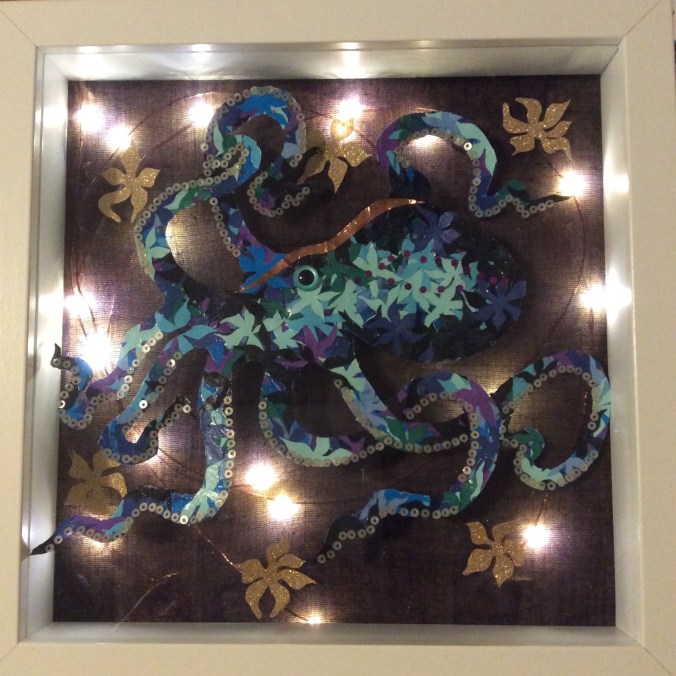
One of my blocks over the last few years has been in finishing things. I don’t know if this is a typical ‘scanner problem’ but I am pretty good at getting dug into a project, and then, about half way through there seems to be another project that I need to start, so I do. And then another. And another. The banner picture on my blog at the moment is a blanket I made for my sister. It took a whopping 7 years to finish that baby off. 7 years. And I was so proud of it that I took pictures of it before I handed it over to use on the banner of this blog. So in contrast to that, this little guy in the picture above only took around six months. And look, he lights up…

img_0100

Many of my ongoing projects are quite ambitious, there is a play, a film and a novel, and now a book about art and wellbeing. I’ve struggled to get close to finishing any of these things and this was beginning to cause lots of creative angst. One of the strategies I’ve come across in the mental health world, and in the online world of inspirational businesses, is the idea of goal setting. Of particular use to me has been setting smaller goals, by which I mean developing much smaller projects that are I could potentially finish in a few weeks (it still takes a few months but never mind). I’m finding that in actually finishing some things I feel much more motivated to return to those more ambitious, difficult projects, and I feel better for it. It’s helping, that the play is actually looking in good shape to send somewhere soon.


Creativity and Catharsis

p1000284

I’ve been blogging over the last few weeks about how an arts practice can be a positive thing for wellbeing and mental health. In my last post I was musing on how in the process of making things we transform one set of things (paper and paint, thoughts and feelings) into something else, something beautiful.

I’m interested in the idea that as part of the process of making something, it is possible to use thoughts, feeling, ideas or experiences as a raw material for craft. The concept of artistic expression as a cathartic process is not new. The idea is that the artist may not only use their practice as a medium through which to express feelings, but in the process may somehow expel or ‘purge’ negative emotions from their systems and in doing so would be relieved from them. For many people some negative emotions hold such power that it may be difficult to actually articulate them. A sweep of dark paint across a canvas, or beating of drums or moving the body through dance, may be the way in which a person may actually be able to give some form to those emotions. Once the paint is on the canvas a person may be able to ‘see’ what they are feeling externalised, and feel the emotion is no longer contained within them, but has been ‘set free’. I understand this reading of catharsis as a little like mental vomiting, expelling what is noxious to be rid of it.

A few years ago I was very interested in how story and narrative may have an impact on us humans, and I read the work of (and had the privilege of meeting with) Prof. Keith Oatley, who was very interested in the idea of fictional literature as a kind of emotional simulation. He had a slightly different reading of catharsis that drew on a different translation of the Greek roots. He described how catharsis could be interpreted not as a purging, but as a process of ‘clearing away’ or making sense of emotional turmoil. The experience of being in mental distress can be highly confusing. Some have suggested that through the process of creating art out of an emotional situation, it can be possible to make sense of it. The act of externalising emotion through that sweep of paint on the canvas may not really be effective in removing the emotion from the inside, but what it may be able to do is help make sense of it so that it is ever so slightly easier to live with.

Quick review: Body of work by Pamela Slim

I’ve not blogged this week as I’ve not really been at my best, and have been doing the ‘one thing at a time’ thing this week. I’m not going to do a long piece now should be back tomorrow with something a bit more interesting. I have, however, been enjoying the book Body of Work by Pamela Slim. She’s written a book about what work could mean in what is now a rapidly changing situation. The style of working that involves a job at the same place, in the same career path, for the majority of your career is becoming less common and indeed less possible to sustain. Many more people, through choice or necessity, are developing ‘portfolio careers’ with multiple strands, gigs and projects. I think this can leave some of us feeling a bit disoriented, and unsure exactly how to shape that kind of way of working in a way that may make the most of our varied talents.

I really liked Pamela Slims approach to thinking about this. In the book she makes the argument that over a lifetime we should look to create a Body of Work – so a collection of different projects and occupations that form a substantial contribution to society. I think what I particularly liked about this is how she writes about finding your own narrative. The book has a series of mini projects and exercised throughout the book that are designed to allow you to gain a sense of what your own narrative may be and how to tell that story about your body of work. I think in the past for me this has been a difficulty, I have worked in academic research in a number of areas, and tried to nurture my creative interests outside of that, and everything felt a bit bitty (I’ve recently found out there is a name for people like us, ‘Scanners’). Pamela Slim suggests that everyone should have a ‘Side Hustle’, which is very sensible, but some of us have more ideas for side hustles than time to really work them. I think the idea of working out what you narrative is can really help with that, as it can allow you a framework to work out which projects are worth prioritising, and which ones can wait a little. I am now working much more specifically to attempt to create more space for the creative interests and skill development. I think this book is another step in helping scanners or multipotentialites make sense not only of who we are but also who we can find a way of working that fits more naturally with our way of being. So in sum, I liked it.

Making and mental health: Arts as a transformative practice

img_0076-1I have been musing over the last few weeks in what has turned into a little blog series about how having an arts practice can be a positive thing for mental health. It certainly works on some level for me. Over the last few years I keep coming back to the idea art as a transformative practice in the projects I have started (and often not really finished – I have the multipotentialite problem of too many projects and not enough time). One of the characters in a novel and then in a play I have been (am still) working on was directly concerned with this idea, and I’ve often spoken informally to artists of have had similar thoughts about it.

The act of Making is one of transformation. We take all manner of things, objects, paper, paint and glue and in combining those things through various techniques we transform them into something new and possibly unique. For many artists one of those ingredients is feeling. The act of using good feeling or bad and channelling that into a project to transform into something else is an profoundly creative act. The idea that emotions can feed creative work has been around for a long time, as has the stereotype of the ‘troubled artist’, so I am doubtful that this is a new idea to many reading this. I think it is this ability of an arts practice to allow the expression of feeling that can make it particularly positive. It can be a way of expressing, and gaining clarity, on what is going on for a person without requiring them to directly verbalise it. Potentially for many, expressing themselves through visual means, or through music, makes far greater sense that attempting this through what can be the very limiting medium of words.

I’m not suggesting that all art is about this process, for many art can also be a restful or pleasing diversion. But frequently the art that speaks to me most speaks to me on this level. A really useful way of thinking about this for me came through reading Amanda Palmer’s Book ‘The Art of Asking’ (I really enjoyed this one, more on this another time). There are a lot of useful ideas in here, but the one that grabbed my interest in particular was the idea of the artist as ‘Sin Eater’. Traditionally the Sin Eater was a person who may live at the margins of a community. Their role was to take on the sins of a person who had recently died so that person would be able to pass on to heaven. In Welsh communities the Sin Eater may visit with a family and break bread and drink ale over the body of a loved one to ‘eat’ their sins. In ‘The Art of Asking’ Amanda Palmer speaks about the artist as the sin eater, as a figure who is able to take on the sadness, anger or distress of others and transform that into something beautiful, into art. I found this description particularly useful to think about, and in understanding the function art can play in helping us understand ourselves.

Business bites: Ethics and affiliate marketing

When I set up this blog one of the things I was interested in learning about was if it was really possible to earn a living by being ‘online’. I’ve been exploring how to do that and have read one or two (badly written) books about earning ‘passive income’ that didn’t really help me that much. I’m not going to name names, but I felt that had probably been written at speed, possibly as an attempt to create a passive income product in themselves, and lacked practical detail.  Both had an underlying passive aggressive tone that suggested that anyone who wasn’t trying to set up their own online empire was basically an idiot. This is of course rubbish. There are many splendid and enjoyable ways of making a living that don’t involve owning a website.

In the last 2 weeks I’ve been looking at the idea of affiliate marketing and found a bit more concrete information. The idea is that you can sign up for an account with programme like Amazon associates  and they will then pay you a small commission every time they sell something through a recommendation you make on a blog or other social media platform. For Amazon affiliates the process is that you open an account that will allow you to search for products that you have used. It will then generate a link for each product that you select. The link has a special bit of computer code in it that will connect to you and your account. You can then use this link in your blog posts – if anyone clicks through from your blog and goes on to buy the product you get a little kick back.

The psychological principle behind this is a simple one. People are more likely to buy something when someone they know and trust has already tried it, liked it and recommended it. I studied the principles of persuasion through my PhD and I think the evidence then (8 years ago now) was pretty strong in suggesting that personal recommendations will be far more successful in selling a product than advertising alone. So the psychology behind this is pretty straight forward, however it does leave the affiliate with an ethical problem. The more things you link to, the more your earning potential increases. This in itself isn’t ethically problematic, but it leads to the temptation to link to just anything you happen to see while browsing. Given that the principle is based around trusted recommendations, it’s a breach of that trust to link to things that you’ve not tried, or that you don’t like or didn’t find helpful. So I think it is possible to be an ethical affiliate, and but it takes a little thought about what you are linking to.

I opened an account last week (it was very simple to do this – I’ve linked the site above). I’m going to be using affiliate links in the blog to see whether in reality you can make much money this way. My blog currently generates very little traffic so I’m not setting high hopes for this experiment, but will update you if I turn out to have been wrong on that. My ethical line on this is that I’m only going to link to products or books that I have used or read myself AND have found helpful.


My first re-blog…

I’m pretty new to blogging but one of the blogs I have been following is Craft and Other Crazy plans. She’s suggested we do some re-blogging this morning so here I am – in particular check out her A-Z of crochet – good stuff….

First of all If you reblog this post you help me, I help you and you help your readers, so everyone wins.. There are thousands of good blogs out there and think of all of that we are missing just b… Source: Share your blog!

via Share your blog! — craftandothercrazyplans

Business bites: bank accounts

I’ve gained a load of new followers this week. Hello! So lovely to see you over here. For the who are new (which is the majority) one of the threads running through this blog is a exploration of how easy it is to start up an online creative business from scratch, and from a very small initial financial outlay. I had been experiencing quite a lot of anxiety at work and was looking for ways to reduce my hours and put at least some of my working efforts into my own creative projects.

As someone who has always worked for someone else, I have no previous experience in business, so am learning as I go along what is possible, what is difficult, what is confusing. I’m taking a social sciences approach to the research, reading books and talking to people. This week I’ve been getting myself snarled up in the finances side of things. At the moment I’m not making any money, so I’m not too worried about the confusions here, but there is a lot of confusion. I’ve been reading this book ‘Refreshing simple finance for Business’ by Emily Coltman,which is very helpful, and I have learned the following;

Running a tiny business on my own which brings in at the moment very little money (nothing at all) means I can set myself up as a sole trader. This means I don’t have register as a limited company at companies house, or get an accountant. It does mean I have to register my self for tax purposes after the end of the tax year in which I started the Magpie, and will need to do a self assessment, pay tax on my income, and probably some extra national insurance. So far, so clear.

However, this book, along with others, advises that while you can probably use your own bank account, it’s better to have a separate one to keep you business transactions separate from your personal ones which will make the end of year accounting much easier. This is where I hit problems. Most basic current accounts don’t let you use them for ‘business purposes’. So I looked at ‘Start up’ business accounts, and there are several that will allow you to bank with them for free for the first 18-24 months while you are getting up and running. However to apply for one of those you need to give an estimate of your anticipated annual turn over (um…) and have a business plan (should probably have thought about one of these) and you need some tax reference numbers that I don’t understand (possibly don’t have yet). So I’m going to need to go to a bank and talk to someone about what I need to do. I will let you know how I get on.