So this is what I get up to midweek, while watching old episodes of Startrek. Exciting times….
So this is what I get up to midweek, while watching old episodes of Startrek. Exciting times….
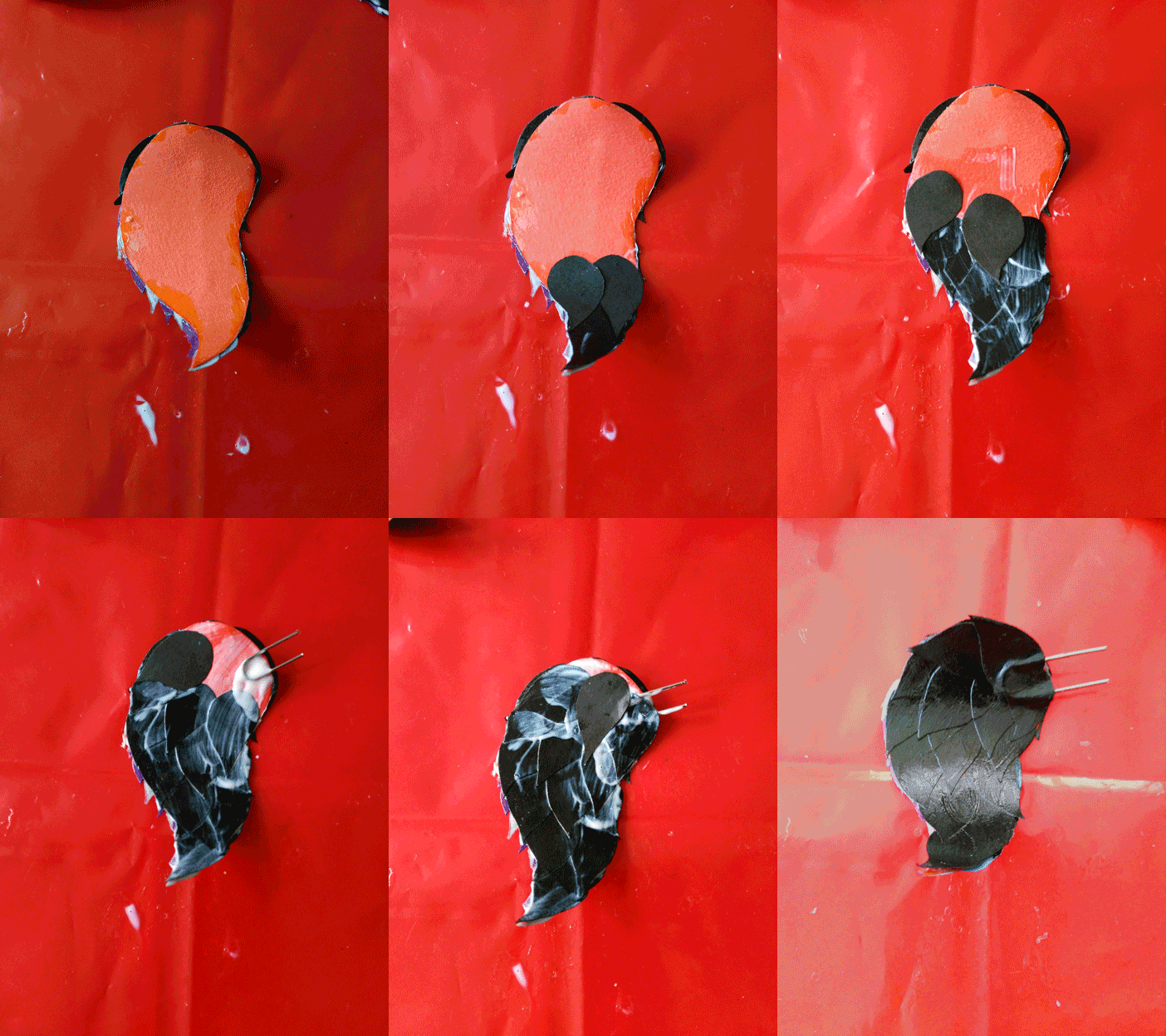
I’ve not been very well so instead of doing a bunch of important things including working out some of my tax bits and pieces I’ve been lolling about on the sofa watching the telly and playing with glue, and teaching myself how to make a gif on photoshop. Here’s my efforts (it works! Yey to ill me) – it’s the underside of a magpie wing I’ve been making for Christmas decorations (if you are interested, I’ve put together a materials list here of the stuff I’ve been using lately).
[EDIT: So I had a nice formal sounding title for this post, but then I went and changed it because this feels better in getting across what I want to say]
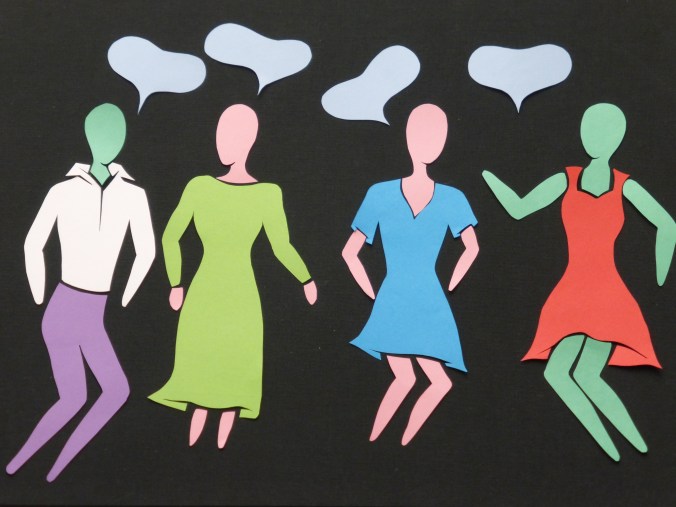
I was procrastinating before work this morning and read this article from George Monbiot on the Guardian website about neoliberalism and loneliness and mental health. I thought it was an interesting article and feel he has a number of valid points about how the two things are connected. I was particularly interested in the scientific work he referenced about the link between stress, pain and physical contact. Anyway it’s a good article – I’m not going to re-write what he says here – go check it out for yourself.
The article this morning happened to come to my attention just two days after I had stumbled onto the work of Prof. Paul Crawford from the University of Nottingham after I me him during a day job event. Paul has been suggesting some really interesting ideas about how we enable people to use arts, humanities and creativity in looking after their own mental health and in their recovery from mental illness. He has a particularly interesting ideas around some form of collective healing through arts and humanities. He’s recently published a book called Health Humanities on the subject with Brian Brown, Charley Baker, Victoria Tischler and Brian Abrams. I’ve not read it yet but I’ve downloaded it and will be putting it on the list.
Both Crawford’s talk and Monbiot’s article have lead me to thinking a bit more about our culture and the role of arts in it. I feel over the last decade and probably for longer there has been this odd political positioning of people who are ‘Artists’ who get to do the making of things, and the rest of us as consumers, who are consumers who are meant to buy things. And things have become very easy, and very cheep to buy. This feels like quite a different situation to the one my parents and grandparents grew up in. My grandfather would probably not have called himself an artist, but he could make anything, and it was common for people to make things for each other, like jam. I like jam.
When I was younger I think I had quite a dismissive attitude towards people who made things (unless they were one of those special, magical, serious people, a proper artist), especially people who made things in groups or clubs. I was a child of the 80s, and while I grew up in the countryside without much stuff, the prevailing political climate was one of stuff worship (and not hand made stuff either). I’ve completely changed my mind about this. For people to gather together to share their making, like a meal, or to make things together, like kitting or music, or in staging a play, is a profoundly creative act. To be connected to each other through our creativity is a profoundly human one.
I think there is a backlash towards this at the moment, and it is thrilling. The internet used to be full of cats. Now it is full up of people having a go at being artists. And crafters and cooks and gardeners and poets. And people making Jam. It is full of artists cheering on other artists. A community or creatives supporting other creatives. Brilliant. Don’t for a minute think about stopping you lovely bunch of creatives.

A finished thing. The kissing gate. Copyright Rose Thompson. All rights reserved.
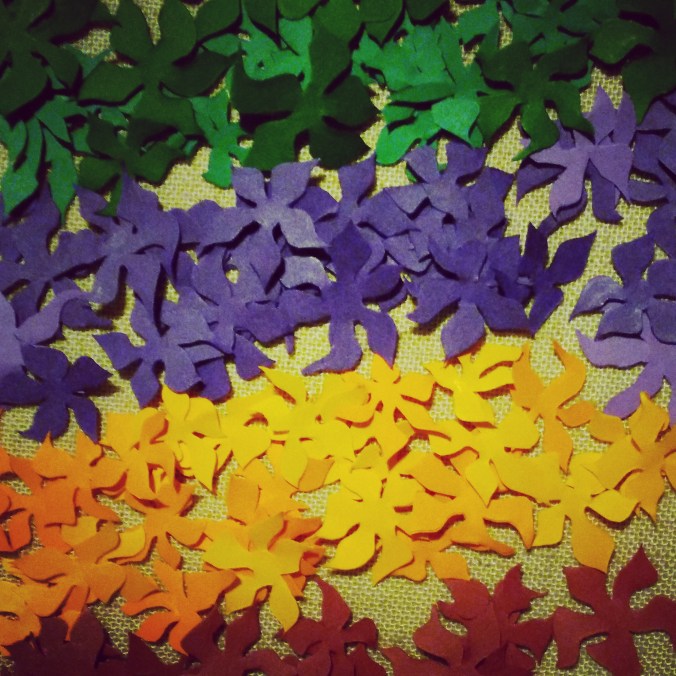
I recently did a mindfulness course to help manage the anxiety I’ve been experiencing around work and other aspects of my life (mostly work at the moment). We did lots of meditations and breathing exercises and lying on the floor, and it was helpful. But taking the practice out of that classroom and into my everyday life has been a bit of a challenge. The one place I have found that mindfulness fits quite naturally with what I do is where I’m in the middle of making something.
I find I can sit and cut the little beauties above for quite some time and keep my sense of presence with the motion of the scissors and the curve of the petal. I use these flowers or stars or whatever you want to see in them in several ongoing projects at the moment, accumulating bagfuls of different coloured flowers as some painters may accumulate paint.
I know many people are finding colouring books helpful, and I have some really beautiful ones, but I have to say that they are not for me. I don’t seem to be able to focus in the same way when I’m working to someone else’s design. The other creative space I have found for a mindful practice is crochet. I’m only just learning this one, but there is something calming about the process of producing loop after loop, and working those looks into a growing creative whole.
There has been much said about the mental health benefits of creative work. I suspect that the mindful element to it is only part of what is happening and the way in which art can provide a useful channel for expressing, sharing and understanding emotions is potentially far more powerful in helping people. But I’ve found in my own creative space, a little work on mindfulness has been very helpful for me.
 A few weeks ago I watched a documentary about origami on Netflix called Between the Folds. The documentary covered a whole genre of origami called wet folding, that I had never heard of before. The premis is that you work with wet paper to produce fluid, soft form paper sculptures. The results were really beautiful, and the doc is well worth a watch.
Both my parents are artists and when I was young my dad taught me how to stretch paper when you want to paint to avoid it warping when it makes contact with water. I think this was probably the first time I’d encountered a way of working with the paper’s memory rather than trying to work against it.
I think about how I work now, which involves paper cutting and sculpture among other thing with paper as trying to work with a paper’s memory. Whatever you do to paper will change it, even after you erase a drawing there will still be a ghost mark of the drawing you first made. In my own work I make the paper or card silouette and then use objects to mould it around before applying more layers of paper and glue. What you get at the end of that is more like a hard shell than a fragile changeable bit of paper so it’s important to work out what the card will remember in terms of shape right at the beginning. Get this wrong and what you get is warping and movement in the wrong direction.
At the moment I’m still in the process of experimenting. What works best? Which is the best way to curl a bird wing? How think is the paper and how long can I fuss with it before it will fall apart? It’s learning in a very physical, tactile and mindful way that’s quite different to other aspects of my life. I’m enjoying the journey so far.
 The Magpie at Midnight