Can Expressive Writing Help your Physical and Mental Health?

When I first came across the work of James Pennebaker during my PhD studies, I was pretty inspired by it. His initial idea was that writing about personal traumas over a period of time could help people process them and begin to heal. This theory came from an observation, made by many different scholars and thinkers over time, that keeping secrets is stressful, and that humans appear to have an innate need to confess.

The nature of the way society often talks about trauma and mental health challenges means that those who experience them often feel intense shame or stigma around their struggles. While this situation appears to finally be improving, for many people shame has been a hefty barrier to talking about what has happened to them for a long time. For example we are only now beginning to understand the sheer scale of the abuse that happens to children because many who experienced it have felt forced into silence for so long.

James Pennebaker had the idea that if people were able to write about their experiences, a practice her called ‘expressive writing’, this may form part of a process that would allow people to process what had happened to them and begin to heal. One of the advantages of expressive writing is that it’s possible to do this in private, or to share it with people you trust, either way you have control over who sees it.

What is expressive writing?

In their book, Opening Up by Writing it Down (affiliate links – if you use these links to make a purchase I’ll get a tiny commission), James Pennebaker and Joshua Smyth describe expressive writing as “a technique where people typically write about an upsetting experience for 15-20 minutes for three to four days (Pg. ix).”

They are not prescriptive on the number of days, or the time spent writing each day, and actively encourage people who are interested in this practice to experiment with what works for them personally. They suggest that this kind of writing exercise allow people to spend time gaining a better understanding about the feelings that have about what has happened to them.

What is the theory behind it?

Pennebaker and Smyth note that having traumatic experiences is bad for your health, and suggest that some traumas may have more insidious effects than others because the nature of them, as I suggested above, means that people feel unable to discuss these important personal experiences.

They describe keeping “major secrets” as stressful, having a numerous negative biological and psychological impacts including reducing immune function, impairing the work of the cardio-vascular system, agitating the nervous system and even impacting on the chemistry in our brains. Sustained over long periods of time these effects can lead to physical illness and mental distress.

By contrast finding a way to release or confess secrets, particularly ones that are difficult or upsetting, can relieve the pressure on our bodies and minds and help reduce both distress and physical illness. Expressive writing may be one way of releasing those secrets.

Evidence

Pennebaker first described his technique in 1986, and in the time since then has conducted a vast programme of research with hundreds of research participants. In his early studies he asked college students to write about traumatic experiences for four days in a row, and he found the following effects:

  • Immediately after the writing exercises the students reported increased feelings of sadness and anxiety
  • Over the long term students who had completed the writing exercises reported few visits to the student health centre than control groups of students who had written about non-traumatic subjects
  • Students who had completed the writing exercises also reported feeling a greater sense of value and meaning

Since those early studies Pennebaker and Smyth have conducted a range of experiments on expressive writing with a wide range of people and have found positive impacts on numerous physical and psychological health markers and conditions, including:

  • Enhance immune function, including in some people with HIV
  • Lower blood pressure after expressive writing
  • Improvements in lung health in people with asthma
  • Improvements in joint health in people with arthritis
  • Improved wound healing
  • Improved quality of life in cancer patients
  • Improvements in symptoms of depression and PTSD

Who does it not work for?

After seeing some of the evidence it seems like expressive writing could be a easy and cost effective technique to help anyone. However there are some people who the technique appears to have little impact on.

Some of the studies that Pennebaker and a range of colleagues conducted suggested that expressive writing was most useful to people who did not have other opportunities to disclose, suggesting that for people who do have those opportunities may feel little benefit.

I have also read elsewhere (and apologies as I cannot remember the source) that people themselves writing almost the same account of a traumatic event over and over, rather than seeing their accounts evolve over time, may receive little benefit, and may even find writing about their traumas harmful. It is possible for people to become ‘stuck’ in their story, rather than evolving through it. For many individuals a skilled therapist will be able to help them gain a better understanding of their feelings about what has happened to them where they may struggle on their own.

Further reading

If you are interested in learning more about expressive writing I recommend you read Opening Up by Writing it Down (affiliate links – if you use these links to make a purchase I’ll get a tiny commission), James Pennebaker and Joshua Smyth. It contains detailed information about the research they have conducted, along with practical writing exercises that you can try. I also find written in a clear and approachable style.

Reasons to be Grateful: Allowing myself some grace when I’m not at my best

The best laid plans…

About six weeks ago I had decided to try to be more consistent with writing posts about gratitude. I think they are helpful to me to write them, and they are helpful to some of the people that read them too. Within a week or two of making that decision, I tested positive for Covid, and then was quite poorly for about two weeks.

During that time my little cat, who I had a close bond with, became very poorly. We had been trying lots of things to treat him for a bowel condition, but it turned out that wasn’t what he had. Instead he had an aggressive cancer which just gobbled him up, which was increadibly difficult to watch. I took him to the vet to be put to sleep before I had really been able to recover from Covid, and have suffered a very sticky form of grief for him ever since.

On top of this I still have a busy toddler to look after, who is just going though a ‘boundary testing phase’, and managing this is exhausting. As I write this it’s been at least three weeks since I cleared Covid, and yet I still do not feel like I have recovered from either thing.

Frankly I haven’t been feeling at my best, and times like these can have unexpected results.

Just not finding my muse

I have found myself suffering an odd form of writers block, in which I have the initial ideas for little blog posts, stories, or even longer essays, but as I sit to write them I find it impossible to think through how to elaborate on that initial idea to create something readable.

For about a week or so I put pressure on myself to get back to the swing things and feel ok, and then I realised that I didn’t have it in me for that.

Those who have read bits and pieces of my work before may know I have struggled with anxiety and depression in the past, and those experiences have taught me that it’s not always sensible to struggle on. This time, instead of trying to push myself to write, I decided to take a bit of a break, and have written just a few little bits and pieces in that last month.

A few moments of grace

In the few scraps of time I have to myself in the day I’ve been doing other things instead, taking the time to sleep, to read the fascinating Entangled Life by Merlin Sheldrake (this is an affiliate link – if you buy this book using this link I’ll be sent a few pence as a referral fee), and to cuddle my surviving cat.

As I begin to feel like writing again, I feel grateful that I was able to give myself a little moment of grace to not do things, and to take a little time to rest.

Thank you for reading. I also write, make art and films. You can read my short fantasy stories here on Simily. If you like these prompts and want to get a copy of a free short book of them I wrote, and to hear more about my writing projects please join my mailing list here. You can see my films at my YouTube channel here. You can see things with my designs on at my shop here. Could even treat yourself if you wanted to. Just saying. If buying art is not your thing, but you would like to support what you see you could buy me a KoFi, and I also have a Patreon Page.

Reasons to be Grateful: Unexpected quiet moments with my son

I made a bit of a mistake this morning, and managed to get the whole household up an hour earlier than we needed to. I looked over at the clock on the other side of the bed and mistook a 5 for a 6.

My son was still asleep when I carried him downstairs and settled him on the sofa, and I didn’t wake him as I thought we still had a few minutes to spare. In the kitchen where I made some tea and warmed him a little milk the clock on the cooker alerted me to the fact that I was an hour early, and my partner grumbled a little before heading back to bed.

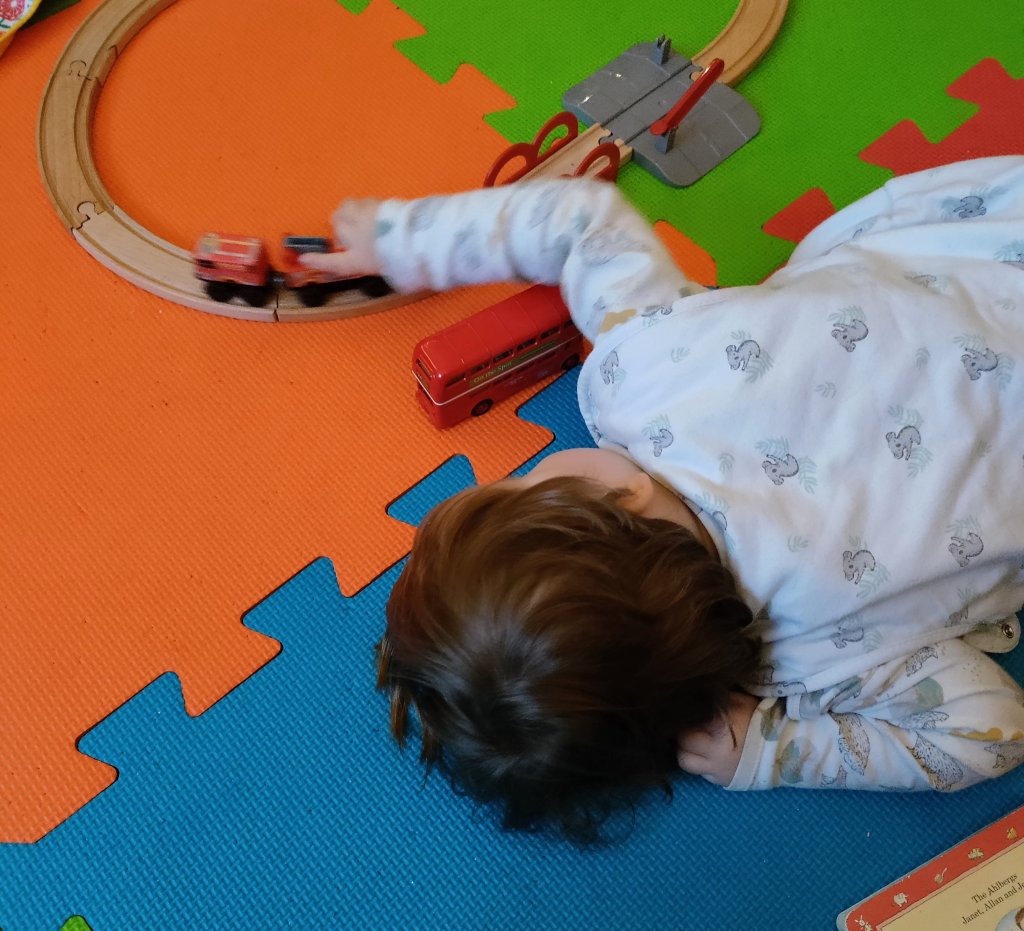
By the time I had returned to the living room my son was beginning to stir and it was too late to get us all back under the duvet. He asked to watch one of his favorite programmes. It’s a program in which an animated gecko teaches toddlers about emergency service vehicles.

My son and are sitting quietly together on the sofa as I type this, and he occasionally points out details of the program to me that capture his imagination. He’s still too sleepy to be rushing around yet, and instead rests his bare feet against my arm and clutches his comforter. The soles of his feet are warm and soft.

It would probably have been good for us all to get the extra hour of sleep, but there is a little magic to these early mornings with him when he’s not quite ready to involve himself in mischief yet, and we can just enjoy a little time together. So I am oddly grateful today that I got us up an hour earlier than I needed to.

Thank you for reading. I also write, make art and films. You can read my short fantasy stories here on Simily. If you are interested in the process of creativity and want to get a copy of my free short book of creative prompts, and to hear more about my writing projects please join my mailing list here. You can see my films at my YouTube channel here. You can see things with my designs on at my shop here. Could even treat yourself if you wanted to. Just saying. If buying art is not your thing, but you would like to support what you see I also have a Patreon page here.

One-Time
Monthly
Yearly

Like my work but none of the above options appeal? You could consider a one off donation instead. I would really appreciate it.

Make a monthly donation

Make a yearly donation

Choose an amount

£2.00
£5.00
£10.00
£2.00
£5.00
£10.00
£5.00
£10.00
£15.00

Or enter a custom amount

£

Your contribution is appreciated.

Your contribution is appreciated.

Your contribution is appreciated.

DonateDonate monthlyDonate yearly

Reasons to be grateful: A sense of peace watching the bees

Like a lot of people I’ve been alarmed by the reports of the steep decline in biodiversity. When we moved into our current house there were some roses in pots, and a few wild flowers in the garden, but the majority of the space was taken up with lawn, and even the grass all looked like it was all the same variety. While we couldn’t fix the global biodiversity crisis, we could try to help in our little corner of London.

Over the last couple of years my partner and I have put quite a lot of work into increasing the diversity of plant and animal life in the garden, by planting new flowering plants, growing fruit and vegetables, and letting those wild flowers that were there before roam a little more freely.

We’ve managed to establish a couple of sage plants which put on an explosive display of purple flowers in late spring, and we also now have some chunky clusters of chives, that produce clumps of violet pompoms. Both of these plants are really attractive to the bees. Now we can sit and watch the local honey bees roam across these flowers collecting nectar, their little legs heavy with pollen.

As I write this we’ve had a stressful couple of weeks, with both my son and my lovely little cat being poorly, along with the day to day stresses that come with work and the rising cost of living. I’ve struggled with anxiety in the past, and it is these times where it is more important to do little things for our mental health. Most days I find a moment to go out into the garden to watch the busy activity of the bees. These are moments that I can really sink into and feel a little contentment in the present.

The flowers on both plants are dying back now, but there are others just geering up to take their place. My son loves to go outside and look for the ants and the ‘bumble bees’ too. It makes me grateful that we put the effort into trying to turn some patches of a tired looking lawn into an attractive place for the local insects.

Thank you for reading. I also write, make art and films. You can read my short fantasy stories here on Simily. If you are interested in the process of creativity and want to get a copy of my free short book of creative prompts, and to hear more about my writing projects please join my mailing list here. You can see my films at my YouTube channel here. You can see things with my designs on at my shop here. Could even treat yourself if you wanted to. Just saying. If buying art is not your thing, but you would like to support what you see I also have a Patreon page here.

One-Time
Monthly
Yearly

Like my work but none of the above options appeal? You could consider a one off donation instead. I would really appreciate it.

Make a monthly donation

Make a yearly donation

Choose an amount

£2.00
£5.00
£10.00
£2.00
£5.00
£10.00
£5.00
£10.00
£15.00

Or enter a custom amount

£

Your contribution is appreciated.

Your contribution is appreciated.

Your contribution is appreciated.

DonateDonate monthlyDonate yearly

Ideas from science to boost your art: The restorative impact of nature

Before I started writing this blog post I took a walk in a nature park that is close to my home. I had spent the morning trying to upload my film to a website in order to submit it to some festivals (more news on that to come), and was in need of a creative reset before I started working on a different project. I frequently find that a walk in a wild place will help me think through what I want to say or do next on any number of my creative works in progress, and it has significant positive impact on my mental and physical health too. I’m not the only one who finds this, and the positive impact of being in green or blue spaces on humans has been established for some time.

This is why I wanted to discuss some of the ideas of Rachel and Stephen Kaplan in this next ‘ideas from science to boost your art’ post. I came across their book, The experience of nature: a Psychological perspective while working up a proposal for a project at work. It’s an old book, published in 1989 and doesn’t appear to be in print any more, but I was able to access it for free here.

The book outlines a theoretical perspective on how natural environments are beneficial to us, and then brings together a lot of evidence to support different parts of the theory from psychological studies that the authors and their students conducted around that time. I really liked how they described an inclusive understanding of natural environments on page 2 as “places near and far, common and unusual, managed and unkempt, big, small and in-between, where plants grow by design, or even despite it.”

I’m not actually going to write about the evidence here. This is partly because the evidence is likely to have been built upon in the thirty years since it’s publication, and should I try to update that here this would turn into a very long blog post. It’s also partly because I think the basic ideas are something that may be helpful and thought provoking to creatives and non creatives alike. Given the book is 368 pages it’s unlikely that I’ll fit everything into a thousand words or so of a blog post, and I have also simplified things because of this. If you like what you see, try giving it a read.

Humans and information

They begin by describing how human beings are highly dependent on information to function, which they hoover up from their environments through all the senses available to them. The brain is in a constant state of sorting through which information is important and requires some sort of action, and which is not. In order to do this hoovering and sorting the brain can engage in two different types of attentional processes:

  1. ‘Involuntary attention’ – the kind of focus you may have when engaging with something you already find interesting. This kind of attention is relatively low effort, and enjoyable
  2. ‘Directed attention’ – the kind of attention you have to work at. If we think about this as writers, it’s the kind of attention you may need to sustain your concentration through a difficult scene or a series of picky revisions or edits. Sustaining this kind of attention for extended periods of time can result in mental fatigue, even if this has been in the pursuit of a project that is enjoyable.

They then make the argument, which feels intuitively right to me, that in modern society we have constructed urban environments and social structures that constantly provide us with lots of interesting and distracting information, and thus there is lots of ‘sorting’ to do between the information that is just interesting, and the information that requires action. As a result we frequently engage in directed attention, which can result in mental fatigue.

Mental fatigue

For most writers and creatives, especially ones like myself who are trying to fit creative stuff in around other bits of life, I think that mental fatigue may be a familiar feeling. It is the state where someone may feel ‘worn out’ without necessarily having engaged in any physical activity. They even note that people who experience this may complain that they have not engaged in enough activity.

The consequences of mental fatigue may be familiar too. People who are mentally fatigued are more likely to commit human errors and to be aggressive, less tolerant, and less sensitive to socially important cues. So here is the explanation for that gaping plot hole that you didn’t notice first time round in that bit of the book you wrote while really tired and highly caffeinated.

Restorative environments

The bulk of the book is dedicated to building a case around why natural environments may be ‘restorative environments’, by which they mean environments that facilitate rest and recovery from mental fatigue. They cite four different characteristics that environments they consider to be ‘restorative’ have:

  1. The sense of ‘being away’ both from one’s every day concerns and responsibilities, and from noise and cluttered urban spaces
  2. The sense of being in ‘a whole other world’ in which things may look and feel quite different
  3. They are inherently fascinating, and easily engage those processes of ‘involuntary attention’ we met earlier
  4. They are compatible with the things that people like to do

The descriptions of these four types of characteristics are quite long and detailed. I’m not going to paraphrase them here as this blog will never end, and I feel like these characteristics will intuitively make sense to a lot of people. If you do want to read about the detail, the relevant sections start from page 184.

I think many of us can see how being in a natural space may fit the bill for all of the above. Being out in a green or blue space means we are away from our desks, our work places, perhaps even our caring responsibilities, and things feel quite different there. Allowing ourselves the time to pay attention to the plants and insect and other animals can feel like being in a whole other world, and is, for many people, inherently fascinating. Being in calm green places allows many of us to do things that we enjoy, like hiking, cycling or sitting near bodies of water.

Recovery from mental fatigue

The final aspect of this theory that I think is really helpful for creatives is their discussion of how being in a natural environment can help us recover from mental fatigue. They suggest this can happen at four levels:

  1. Clearing the head and allowing your mind to pack away the ‘cognitive leftovers’ from a recent task or project
  2. Recovering our abilities to engage in the processes of directed attention, i.e. our ability to concentrate
  3. The ‘soft fascination’ that is induced by exploring the plants and creatures of a place allows for a kind of cognitive quiet which may give space to think about things that are ignored, or not felt to be important on a day to day level
  4. The space for deeper reflections on one’s life , priorities, actions and goals

For me I think the most important take away from these ideas is that as a creative, the key to being productive and having good ideas is not to work on this or that project in every spare moment as western culture may sometimes suggest. Rather, those moments when we step away from our desks and out, into the garden, or away to the park are really important for our brains to be able to function when we do next sit down to work on something. Personally I found this insight really helpful as I often feel a bit guilty when I take an hour out of my ‘art day’ to walk in the park, and perhapse I don’t need to feel like that at all.

I hope you have found this blog interesting or thought provoking. If you have thoughts or comments, I would love to hear from you.

Thank you for reading. I also write, make art and films. You can read my short fantasy stories here on Simily. If you are interested in the process of creativity and want to get a copy of my free short book of creative prompts, and to hear more about my writing projects please join my mailing list here. You can see my films at my YouTube channel here. You can see things with my designs on at my shop here. Could even treat yourself if you wanted to. Just saying. If buying art is not your thing, but you would like to support what you see I also have a Patreon page here.

One-Time
Monthly
Yearly

Like my work but none of the above options appeal? You could consider a one off donation instead. I would really appreciate it.

Make a monthly donation

Make a yearly donation

Choose an amount

£2.00
£5.00
£10.00
£2.00
£5.00
£10.00
£5.00
£10.00
£15.00

Or enter a custom amount

£

Your contribution is appreciated.

Your contribution is appreciated.

Your contribution is appreciated.

DonateDonate monthlyDonate yearly

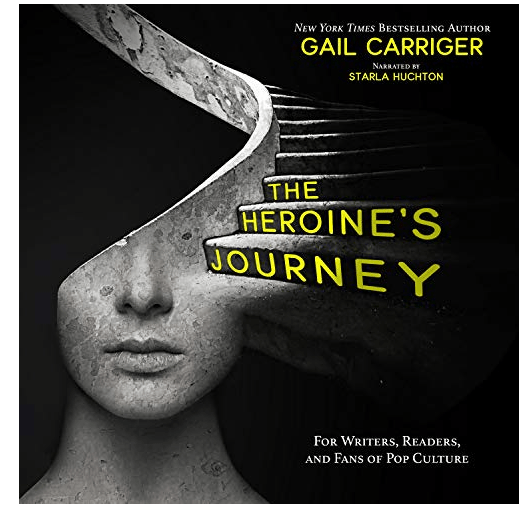
The Heroine’s Journey is the narrative template we all need right now.

I’ve been sitting on this post for quite a while now, having first drafted it when I was listening to the audiobook of The Heroine’s Journey by Gail Carriger (affiliate link) back in the summer on Audible (affiliate link). I’m not really sure why I’ve held on to it for so long, other than I wasn’t quite clear on what I wanted to say. But a few weeks before the holiday season begins feels like an appropriate time to put this put there, so I’ve tried to pull those thoughts together a bit more coherently.

Anyone who has tried to write long form fiction will have heard about The Hero’s Journey, which was described by Joseph Cambell in his book The Hero With a Thousand Faces (affiliate link), which is a kind of narrative template that forms the backbone of many, many books and films and describes the archetypal ‘journey’ which will take a hero from the start, to the end of the story.

I had come across this template when I was completing my PhD in the psychology of stories and how they influence us, and found it an interesting and useful tool in helping to shape a story in progress. However, over time I have become increasingly troubled. I’m not going to go into the specifics of the template, as this has been done many, many times before, but the main point of the journey is that while a hero may pick up many comrades along the way, to eventually save the day he must face the major challenges alone. When he returns home, he is so deeply changed by his journey that he may not be able to find his place there again.

My main beef with this, apart from being such a poor representation of so many of the real life major human triumphs, is that is sends such a troubling message. The kind of individualism glorified by the Hero’s Journey implies that anyone who needs help, who can’t defeat their deamons on their own, is essentially weak. I’m thinking specifically through a mental health lense when I say this (I have worked in mental health research for almost ten years). This is not the first time that I have said that we need better stories about mental health, and I really think that the focus on doing it alone, or failing alone, is part of the problem here. But my thinking hasn’t got very far on how we do that. As we all know, it is easy to point out a problem, but not nearly as easy to point to a solution.

Luckily for me, Gail Carriger has written a really great book about the alternative narrative framework, The Heroine’s Journey. If you have not read it, and you are interested in telling stories that offer an alternative to the ‘going it alone’ narrative, I strongly suggest that you read (or listen to) this book.

I’m not going to do a thorough summary this complex and rich book here, as that wasn’t my intention when I wrote this post. The headline is that Carriger carefully unpicks the Hero’s Journey, and explains exactly how the Heroine’s Journey is different. The main point that I am attracted to, both for my own work and for the more general message it sends, is that strength comes from building and working with a community of like minded people. The heroine will collect together a group of trusted co-travellers, seek collaboration, compromise and peace rather than revenge, and will prioritise protecting the people she loves over the glory of a victory. Through this process the heroine will get to know each one of her co-travellers, undertand their talents, and when the time comes, give them their moment to shine.

As Carriger states, to the heroine, ‘Asking for help is not seen as a weakness, it is the very definition of her strength,’ (I’m really sorry, I don’t know the page number for this) which for me is an essentially positive message with particular relevance to mental health.

In these difficult, and isolating times, we need to move past narratives that further promote the kind of individualism that can be toxic to mental health and look to something that helps us reclaim the value that can be found in connection and in community.

The Heroine’s Journey is the narrative template we all need right now.

Thank you for reading. I also write, make art and films. If you creative prompts and want to get a copy of a free short book of them I wrote, and to hear more about my writing projects please join my mailing list here. You can see my films at my YouTube channel here. You can see things with my designs on at my shop here. Could even treat yourself if you wanted to. Just saying. If buying art is not your thing, but you would like to support what you see I also have a Patreon Page here.

One-Time
Monthly
Yearly

Like my work but none of the above options appeal? You may want to consider a one off donation instead.

Make a monthly donation

Make a yearly donation

Choose an amount

£2.00
£5.00
£10.00
£2.00
£5.00
£10.00
£5.00
£10.00
£15.00

Or enter a custom amount

£

Your contribution is appreciated.

Your contribution is appreciated.

Your contribution is appreciated.

DonateDonate monthlyDonate yearly

Reasons to be grateful: an overgrown garden lawn

It’s now November in the UK, and Autumn has really settled in. I really love this time of year, as the leaves turn red and fall to the ground, and we begin to experience some of the more atmospheric weather that I find inspiring. The other morning we were treated to a dense mist as I walked my son to his nursery. He had not really seen mist before, and spent a good portion of the journey pointing into the air and squeaking. It was a nice reminder that for him, many of life’s more normal experiences are completely new.

I planned to write this post several months ago, but somehow couldn’t get it together to write it. I had the idea for it when I was really struggling with some work related anxiety, but hadn’t yet felt ill enough to take any time off work. Since that time I did take a few days off work, before rushing back in again to do something that felt important at the time. A week later my son came home with a fairly common childhood disease, and not long after that I was really ill with it for a couple of weeks. I think my immune system was left struggling after I rushed back to work too soon, a mistake that I will try not to make again.

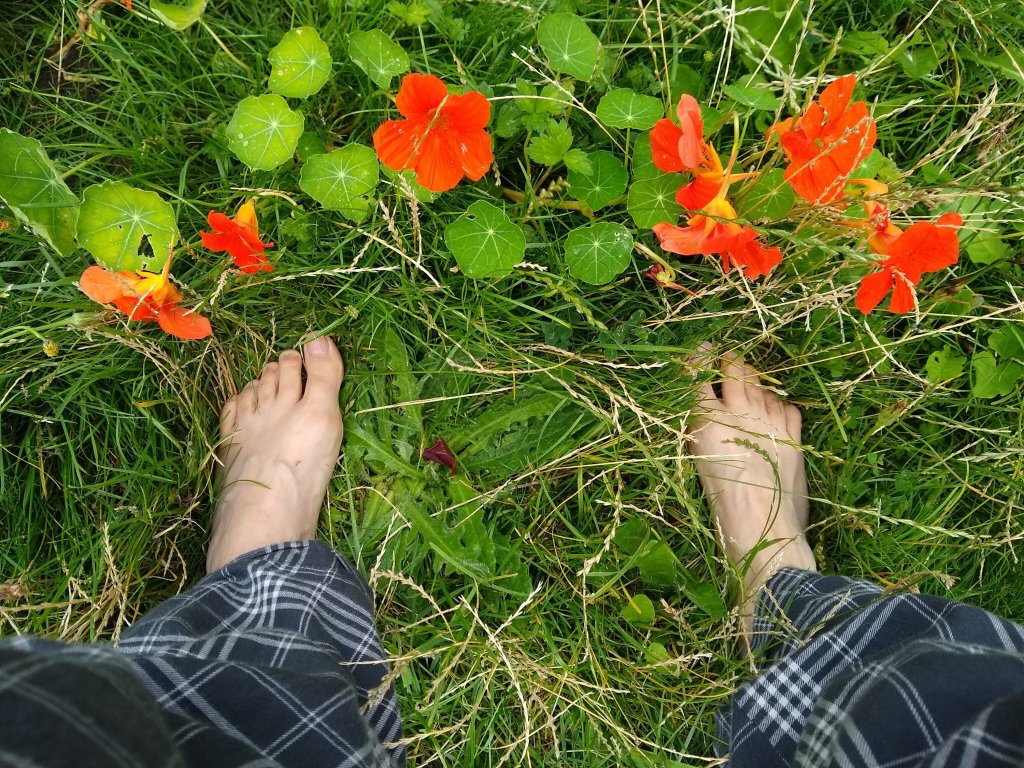
It is too cold to stand out on the grass in my bare feet now. But this summer I was enormously grateful that when I was feeling stressed I could walk down the stairs and out to my garden, where we are lucky enough to keep a rather untidy lawn. I like to feel the cool grass under my feet when I am feeling anxious. For me there is something about putting my feet in direct contact with the earth that is grounding. Things to not feel quite so bad after a few minutes standing quietly and looking at the flowers.

Thank you for reading. I also write, make art and films. If you like these prompts and want to get a copy of a free short book of them I wrote, and to hear more about my writing projects please join my mailing list here. You can see my films at my YouTube channel here. You can see things with my designs on at my shop here. Could even treat yourself if you wanted to. Just saying. If buying art is not your thing, but you would like to support what you see I also have a Patreon Page here.

One-Time
Monthly
Yearly

If you like my work, and want to support it, but non of these options appeal to you, you may want to consider a one off donation here. I would really appreciate it.

Make a monthly donation

Make a yearly donation

Choose an amount

£2.00
£5.00
£10.00
£2.00
£5.00
£10.00
£5.00
£10.00
£15.00

Or enter a custom amount

£

Your contribution is appreciated.

Your contribution is appreciated.

Your contribution is appreciated.

DonateDonate monthlyDonate yearly

Mental health and silver linings

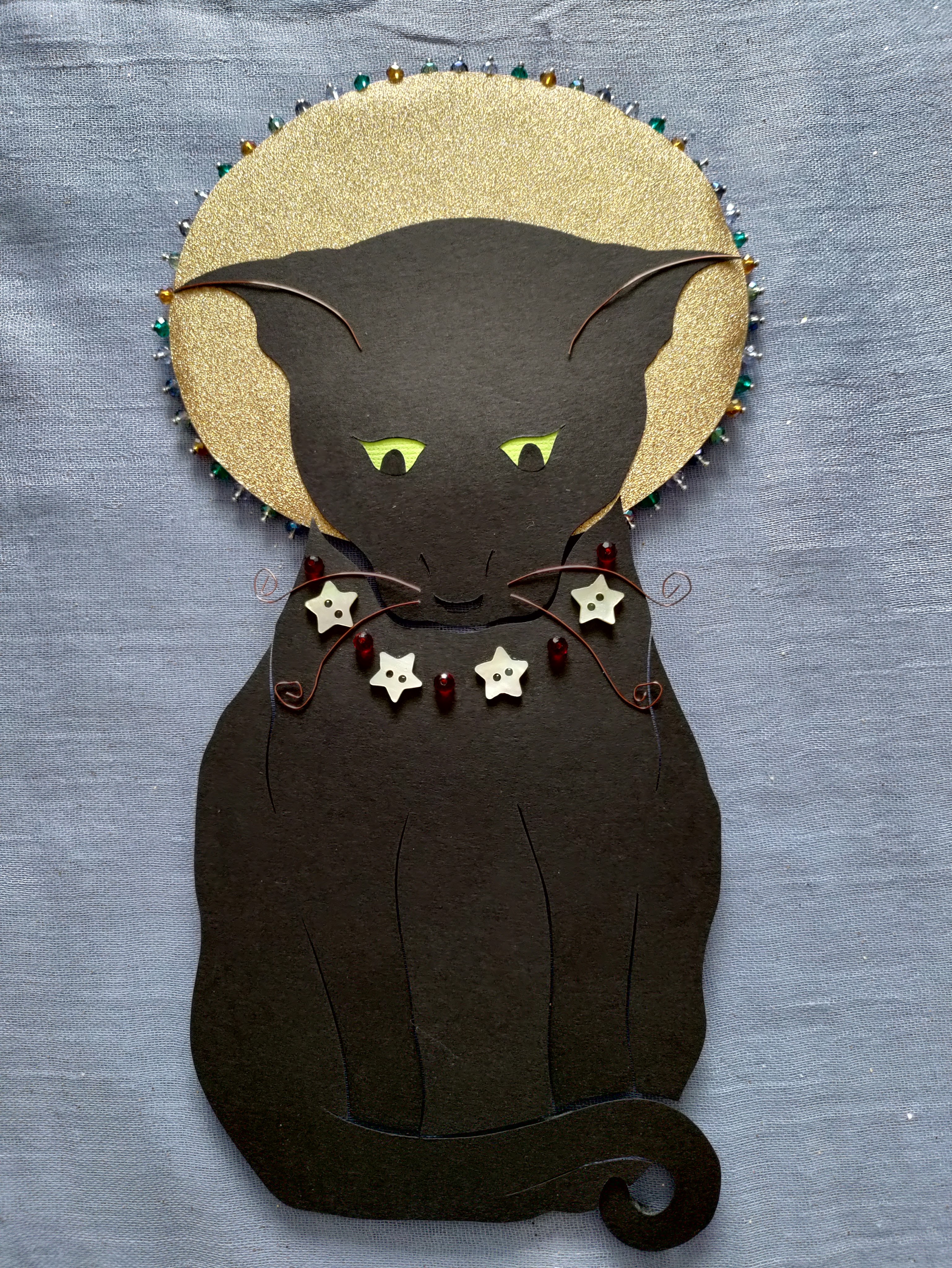
Last week I wrote about my recent brush with anxiety and how at times like this I find that creativity can form a kind of refuge for me. During that time I made a picture of a cat that I rather liked. It’s inspired by my two cats. Both of them are black and a little eccentric, but one of them has displayed some almost saint like qualities in his tolerance of the overly enthusiastic affections of my toddler son.

Over the weekend I had a go at doing some finishing touches in photoshop, and was relatively pleased with the result. So even though I wasn’t feeling near my best in that time, I have come out with a little silver lining in the form of a piece of art.

This is the finished piece above. If you like it, and fancy treating yourself to something with this image on, it’s now available in my shop at Redbubble here.

Thank you for reading. I also write, make art and films. You can read my short fantasy stories here on Simily. If you like these prompts and want to get a copy of a free short book of them I wrote, and to hear more about my writing projects please join my mailing list here. You can see my films at my YouTube channel here. You can see things with my designs on at my shop here. Could even treat yourself if you wanted to. Just saying. If buying art is not your thing, but you would like to support what you see you could buy me a KoFi, and I also have a Patreon Page.

Anxiety and creativity as a refuge

Last week I was off work with stress and anxiety. I’m back in now, but it was a bit of a shock to crash out with a panic attack on a not particularly difficult Monday morning, and find myself unable to return for a few days after that. While I’ve struggled anxiety for quite a long, I don’t normally find myself needing to take time off work with it, but that’s how things go sometimes, isn’t it?

During my time off I was feeling really tired and had that kind of brain fog that makes it a bit difficult to think things through properly. From a creative point of view, I wasn’t been able to write much either, which is my normal creative weapon of choice. When my mental health slips this way my instinct is to retreat into making pictures. I find something therapeutic in the physical activity involved in drawing, cutting paper and working out which other materials may work for that particular design.

There are a few theories about around why creative activities are helpful to mental health, including (not an exhaustive list);
1. That it provides a nice distraction from difficult feelings or circumstances
2. That it may provide a route into a state of ‘Flow’. This is a psychological term coined by Mihaly Csikszentmihalyi, and which describes a positive state of mind where a person is fully involved in and focused on a particular activity (for more information you can read his book on the subject here (affiliate link)).
3. A route for self expression or catharsis, allowing people to express, and more clearly understand their own feelings or thoughts on a difficult situation.

Over time I have probably found all three of these aspects of creativity helpful to my own mental health, and am grateful that it is something I feel able to do. One of the benefits of building some form of creative practice into my everyday life is that when things feel a bit difficult, I have something productive to withdraw into, like this last week.

And I made a picture of a cat that I’m pleased with too.

Thank you you for reading. I also write, make art and films. If you like these prompts and want to get a copy of a free short book of them I wrote, and to hear more about my writing projects please join my mailing list here. You can see my films at my YouTube channel here. You can see things with my designs on at my shop here. Could even treat yourself if you wanted to. Just saying. If buying art is not your thing, but you would like to support what you see I also have a Patreon Page here.

Is it possible to write fiction about mental health well?

Over the last few years I have been writing the first book in a fantasy novel series (current title Feeding Jasmine Valentine). It has two main protagonists, and one of those protagonists has severe anxiety and other mental health issues. The more I write her the more I think about if I am doing justice to her.

One of the really problematic things about writing a character who struggles with their mental health is that there is a really troubling legacy of how mental illness has been portrayed fictionally in the past. For example people with mental illness are often portrayed as dangerous, uncontrollably violent, as an ‘evil genius’, or as incoherent and unpredictable (in what are often quite predictable ways).

There are a number of harmful stereotypes that were easy enough for me to avoid. I have not written my character, Julianne, as a dangerous uncontrollable psychopath or as someone who is inherently prone to doing unpredictable and damaging things to other people. She is not someone who does ‘mad’ eccentric things just for the sake of making a point about her mental health. I’ve tried very hard to give her experiences that are authentic, and have drawn from aspects of my own mental health at times to do so.

The main stereotype I am worried about falling foul of is that of ‘the unreliable narrator.’ Characters that have a mental health problem are often portrayed as inherently unreliable, and thus their version of events is not to be trusted. Over the last few years I have worked closed with many people who have struggles with their mental health and have found this not to be the case at all. The majority of the people I know give very clear accounts of their own experiences. However some of those experiences can be difficult to hear, and it may feel easier to the listener to doubt what is being said.

My concern with my writing is that it will automatically be assumed that she is unreliable, when this is not my intention at all. Any ideas about how to tackle this would be welcome.

Thank you for reading. I also make art and films. You can see my films at my YouTube channel here. You can see things with my designs on at my shop here. Could even treat yourself if you wanted to. Just saying. If buying art is not your thing, but you would like to support what you see I also have a Patreon Page here.