I’m getting to slow to walk about as much as I was, so my street photography opportunities are limited at the moment, but I have been finding other things to take photographs of. I’m aware I’m not posting consistently now, I’m just too tired. Hopefully I’ll get some of my creative energy back in the weeks after they arrive.
We’ve recently been doing a bit of decorating in our house. I’ve hit the point in my pregnancy where ‘heavy’ is the only appropriate descriptor for me, so I’ve not actually been doing the work, but various relatives have been arriving at the house to strip wall paper and entertain my toddler. I am greatful for all of that help.
Recently we removed layers of wall paper in our hallway of a colour scheme too hideous to take photographs of, and underneath it we found this. It’s the ghostly imprint of a previous generation of wallpaper on the plaster, although none of the actual wallpaper remained under the current woodchip.
I live in the UK and have been involved in decorating a number of old houses in my time. Often peeling back layers of wallpaper reveals yet older layers beneath, and it is sometimes sad to have to strip back the history of a place to be able to paint and clean things up.
I often wonder about the people who choose the ancient styles of wallpaper, who they were and what there lives may have been like. They put me in mind of the kind of ghost stories that are set in old, secluded country houses.
The pattern here is floral, and given the way it left an imprint on the plaster it must have been strongly textured. I imagine it was good quality paper, maybe bought by people who hoped to give a good impression to their neighbours.
Who do you think choose the wall paper?
What happened to them?
If these walls could talk, what stories would they tell us?
I’m not a huge fan of creative exercises, so it’s not my habit to tell people what to do with these prompts. There are lots of options – a scene, some flash fiction, a short story, an idea for a short film or a physical piece of art. If you do have a go with this one and would like to drop the result in the comments please do so. I would be very interested to see what people make of these so please do link to blog posts or comment below.
Thank you for reading. I also write, make art and films. You can read my short fantasy stories here on Simily. If you like these prompts and want to get a copy of a free short book of them I wrote, and to hear more about my writing projects please join my mailing list here. You can see my films at my YouTube channel here. You can see things with my designs on at my shop here. Could even treat yourself if you wanted to. Just saying. If buying art is not your thing, but you would like to support what you see you could buy me a KoFi, and I also have a Patreon Page.
I’ve written before about having dyslexia but I don’t often write about the impact of it on me personally. I think in part this is because I was diagnosed more than twenty years ago at university, and while research and understanding have moved on since then, I’ve not been keeping up. Dyslexia is commonly understood as a learning disability that predominantly affects a person’s ability to read and write, but I think recent research is beginning to show it’s more complex than that and comes with an array of advantages too.
I’ve always thought some of my odd quirks were just that, personal oddities that were unique to me, and not the consequence of structural differences in the brain. For example, I’ve always found it easier to read reports and documents I’m working on off physical paper rather than a screen, while this seems to bother other people a lot less. When we moved in my day job over to mostly remote working I didn’t get a home printer as part of my setup, and I think it took me a lot longer to adapt than others.
One of the things I’ve not reflected on is the impact my dyslexia may have on my mental health, specifically the sometimes crippling anxiety I’ve had in the past around work and ‘being productive’. I had always assumed that I was one of the people who had adapted to their dyslexia, after all I have completed a Ph.D., regularly write, and have a job as a researcher in mental health in the charity/ non-profit sector. However, this week something happened that demonstrated to me that the two things may be far more closely linked than I had realised.
Visio-spacial memory and text editing
I did know that there was a link between dyslexia and strong visio-spacial memory, but I didn’t really draw the link across to how this would affect the way I work with text. I’ve always put that in the ‘why you like arts’ bucket of understanding myself and didn’t really think it was relevant to my writing, which I also like to do a lot of.
However this week an incident happened that showed me very clearly how I use visiospacial memory when I work with text-based documents, and how that can go wrong in collaborative endevours. I’ve been working on a project with another person. I think that person is a bit worried I won’t finish before my babies come, and while I was poorly over the holiday they decided to try to help by doing some work on the document.
We’ve moved over recently to working on a shared digital document, rather than having individual drafts that we share after the fact. I think this is really common practice for many people, but we are a bit behind and still getting the hang of it. So without talking to me about what would be helpful, this person went into the document I was working on, re-wrote sections, added sections and moved blocks of text about.
It turns out that for me, having a clear visual map of where the text is on the page in memory is key to being able to progress a piece of work. When I returned to work to find my document changed so significantly in its visual layout, I actually couldn’t remember what I was meant to be doing or what I had planned to do anymore.
I think the worst aspect of this is that because we had been working on a live document, there wasn’t a previous version to go back to in order to catch up with myself, and the other person hadn’t tracked their changes either. For at least an hour or so I felt truly stuck.
Personal links between neurodiversity and mental health
Even on a good day, my anxiety levels are probably set a bit higher than the average person, and in the past, I’ve suffered from significant anxiety, both in relation to work and my personal life at times. At the moment I’m full of pregnancy hormones and riding a bit higher than usual with my anxiety, so emotional regulation is proving to be challenging.
Being confronted with a document on an important project that didn’t seem to be mine anymore sent me into a panic, and within about fourty five minutes I was having a mini breakdown in my bathroom.
I think overall I’ve been set back by a few days as I’ve tried to retrace my steps and get back to where I was before Christmas so I can work productively again. It’s probably taken longer to settle my anxiety back down to a comfortable level again too.
Learning
I guess my big learning from this is that if someone is going to help me write, I need them to agree ahead of time on how they are going to do that helping. I don’t think this is controversial and probably applies to anyone with some form of neurodiversity or work-related anxiety.
I think for people who have some form of neurodiversity, workplaces or creative projects that are set up by people who don’t have those experiences may be more stressful, and contribute to more mental health challenges than they would for a neurotypical person. This is because processes that work well for those people may often have the opposite effect for someone whose brain just works differently.
I know plenty of people who would have been really pleased that someone did some of their writing for them, but for me, it was disorienting and completely disruptive to my thinking and creative process.
It’s certainly helped me think about how I ‘help’ some of my own staff in my day job. I know that several of the staff I have line managed in the past have some form of neurodiversity. Do I always agree with them ahead of time what would actually be helpful? I think I do most of the time, but there are probably moments where the pressure of deadlines and workloads mean that I have fallen short of my own advice here, so that’s been helpful to reflect on, too.
Thank you for reading. I also write, make art and films. You can read my short fantasy stories here on Simily. If you like these prompts and want to get a copy of a free short book of them I wrote, and to hear more about my writing projects please join my mailing list here. You can see my films at my YouTube channel here. You can see things with my designs on at my shop here. Could even treat yourself if you wanted to. Just saying. If buying art is not your thing, but you would like to support what you see you could buy me a KoFi, and I also have a Patreon Page.
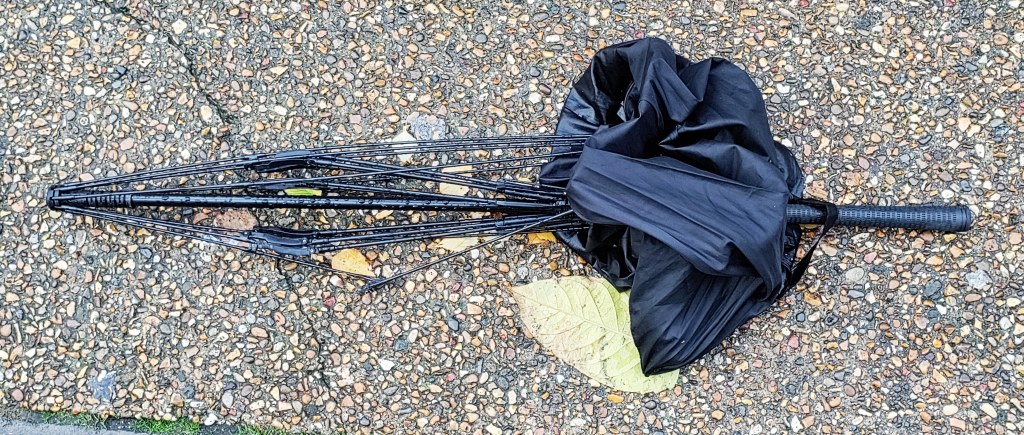
We’ve had some really stormy rainy weather recently, and I’ve seen quite a few umbrellas lost to the elements, discarded on the street here and there. The autumn weather in the UK is always a bit unpredicatble, but it does feel like the winds are getting a little stronger, the storms a little more frequent and severe.
I picked this one to take a photograph of as I was really drawn to the way that the canopy had been almost completely stripped away from the internal mechanism.
The different struts and wires remind me of the rib cage of a strange animal, like the abandoned umbrellas are some kind of odd sacrifice to the weather gods.
Stormy weather is often used in various forms of creative work to change to mood, to indiscate things are about to get bumpy, or that something sinister is about to happen.
Who do you think may have discarded this umbrella?
Where were they trying to get to when the weather turned so furiously on them?
I’m not a huge fan of creative exercises, so it’s not my habit to tell people what to do with these prompts. There are lots of options – a scene, some flash fiction, a short story, an idea for a short film or a physical piece of art. If you do have a go with this one and would like to drop the result in the comments please do so. I would be very interested to see what people make of these so please do link to blog posts or comment below.
Thank you for reading. I also write, make art and films. You can read my short fantasy stories here on Simily. If you like these prompts and want to get a copy of a free short book of them I wrote, and to hear more about my writing projects please join my mailing list here. You can see my films at my YouTube channel here. You can see things with my designs on at my shop here. Could even treat yourself if you wanted to. Just saying. If buying art is not your thing, but you would like to support what you see you could buy me a KoFi, and I also have a Patreon Page.
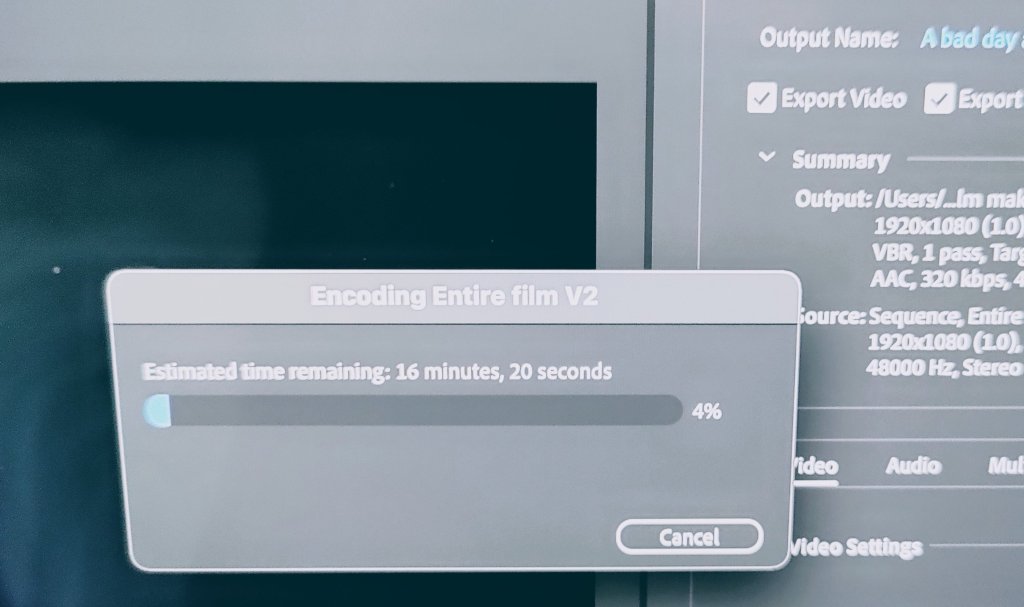
Earlier this year I finally pressed the ‘export’ button on a documentary film I had been making for over 7 years. I ended up working on the project on my own, in my spare time around a full time job, and later 2 house moves and a new baby.
It started out as a project that I did as part of a documentary film making course, which was a six month long part time course. I was meant to produce something that was fifteen minutes long and based only on filmed footage, but what I ended up producing, 7 years later stretches to just over an hour and has numerous animated sequences, which I also produced myself.
The finished film is very much a DIY affair, and is entirely self funded (although after paying for training and buying new equipment I estimate my spending on it to come in under £10,000).
It is the story of a man who was a journalist in Iraq at the beginning of the war in 2003, and who lost part of his leg to a landmine. My aim in the film was to tell the story of this event and his recovery from it.
I’ve entered it into a few festivals but have been knocked back from the bigger ones where I was probably competing against professional outfits. I’m still wiating to hear from some smaller ones, but I don’t really mind this, as entering the film into festivals weas more of a mark of completing the project for me than anything else. For those who know me actually finishing projects isn’t my strong point.
I’m pleased enough with the look, but having made it once there are things I would do differently now. There are definitely a lot of things I learned both about film making and my own creative process along the way.
Technical skills matter
One of the big frustrations I had with that original course is that the tutor spent far more time on ‘ideas development’ than she did on technical skills training. I think that ideas development is really important, and allowing space for that activity is definitely key to a successful project.
However, when I came to try to put some of my ideas into practice I found that I didn’t have the technical skills to do some of the things I wanted to do. Some of those things were quite basic editing techniques, and I needed to go off and pay for more training to really be able to start putting my ideas into practice
Equipment matters
Another problem I had with that orginal course was that the equipment they supplied was very big, clumbersome, and almost impossible to manage on my own. Most of the cameras were really designed for use on sets or bigger productions, not for the DIY documentarian.
I think they intended for groups of students to team up while making their films, but this didn’t work so well on a part time course as we all had different schedules and commitments. The impact this had on me was to make me feel that documentary film making would be inaccessible to me, and to lose courage. But over time I learned this was not the case.
Later I invested in a small digital DSLR camera that records really nice interview footage, a pair of radio mics and some other small bits and pieces. All of this equipement fits in a bag that I can take on the bus with me if I need to.
There are draw backs, in that the DSLR doesn’t like to record footage while it is moving (although it does a nice job with capturing things if it is locked off on a tripod), so I’ll have to supplement my kit at some point with a go pro or a camcorder.
But the lesson here was that with a bit of research I was able to find some kit that worked for me.
Being ‘slow’ is baked into my process
I was reading an article by Dad on the Spectrum the other day on Medium about how people who are neurodiverse take more time to do things. I left a comment about how I used to think I was ‘slow’, but now I know that I just think differently. I think in the comment this ‘slow’ came across as a negative thing, and it probably was at some point in the past.
Now I see that my process of circling through projects and giving each one a rest to breathe for periods of time is probably just part of my process. It certainly slows down my progress, but I think the end results are better so I’m learning to embrace ‘slow’.
I like to make things hard for myself
One of the decisions I made early on was to animate a number of sections in the film. I learned that using film footage is a lot quicker and easier, although maybe less satisfying.
I don’t regret choosing this path, but it was time consuming, labour intensive, and slowed down the whole process even more as I needed to do more training, and learn how to use a different set of software. Still I am glad that I did this as it enriched the experience of making my film.
If after all of that you would like to view the finished film you can see it here.
Thank you for reading. I also write, make art and films. You can read my short fantasy stories here on Simily. If you are interested in the process of creativity and want to get a copy of my free short book of creative prompts, and to hear more about my writing projects please join my mailing list here. You can see my films at my YouTube channel here. You can see things with my designs on at my shop here. Could even treat yourself if you wanted to. Just saying. If buying art is not your thing, but you would like to support what you see I also have a Patreon page here.
One-Time
Monthly
Yearly
Like my work but none of the above options appeal? You could consider a one off donation instead. I would really appreciate it.
In last week’s post I wrote about a Thank-you Note I had spotted on the floor outside of one of our local small supermarkets. This week I had to go into Central London to be in the office for my day job, and I saw this little note on the pavement.
It’s folded up so I don’t know what it says (and I did not unfold it), making this note far more mysterious. It could be all sorts of things, like a set of important points that someone had compiled while revising for an important exam, or a shopping list.
Old school pen and paper is still reassuringly difficult to access from a distance. Most of the time you actually have to get your hands on a piece of paper to read it’s contents, or be sitting very close by. So it could contain important secrets that someone did not want easily stolen.
Maybe it is a love note. The star like patterns on the edge of the page suggest it could be from someone’s personal grimoire detailing an important spell.
The way the note is folded makes me think that at some point someone was clutching it tightly, so it is particularly mysterious that it ended up on the pavement on a sunny morning.
What do you think is in the note? Who wrote it? How did they come to drop it on the pavement?
I’m not a huge fan of creative exercises, so it’s not my habit to tell people what to do with these prompts. There are lots of options – a scene, some flash fiction, a short story, an idea for a short film or a physical piece of art. If you do have a go with this one and would like to drop the result in the comments please do so. I would be very interested to see what people make of these so please do link to blog posts or comment below.
Thank you for reading. I also write, make art and films. You can read my short fantasy stories here on Simily. If you like these prompts and want to get a copy of a free short book of them I wrote, and to hear more about my writing projects please join my mailing list here. You can see my films at my YouTube channel here. You can see things with my designs on at my shop here. Could even treat yourself if you wanted to. Just saying. If buying art is not your thing, but you would like to support what you see I also have a Patreon Page.
One-Time
Monthly
Yearly
Like my work but none of the above options appeal? You could consider a one off donation instead. I would really appreciate it.
I’ve been thinking a bit more carefully in the last few weeks about some of the settings and locations in my fantasy novel series (working title Feeding Jasmine Valentine). I’m in the middle of a new re-write at the moment and have a chance to go back and really think about what I may need to build on the first draft, and how some of the key locations can be more useful in the narrative if I do some more substantial world building around them.
I’m quite a visual person (which may be a Dyslexic thing) and having pictures and diagrams tends to help me, so I spent an hour one afternoon last week on some ‘first take’ sketches of a key location in the first book. There are bound to be problems with my initial ideas, and I’m going to work on these a bit more, but I thought it may be nice to share my first messy sketch here, if only to show I’m still working on it!
I’d be really interested to hear from other writers who use sketches in their world building. How do you do that? Do you think it’s really useful or a form of procrastination?
Thank you for reading. I also write, make art and films. You can read my short fantasy stories here on Simily. If you are interested in the process of creativity and want to get a copy of my free short book of creative prompts, and to hear more about my writing projects please join my mailing list here. You can see my films at my YouTube channel here. You can see things with my designs on at my shop here. Could even treat yourself if you wanted to. Just saying. If buying art is not your thing, but you would like to support what you see I also have a Patreon page here.
One-Time
Monthly
Yearly
Like my work but none of the above options appeal? You could consider a one off donation instead. I would really appreciate it.
However, I didn’t manage to get past the introduction of the paper to get into what the authors actually did, which is a bit of a shame, so I did want to write a bit about that here.
Dyslexia and character strengths
So the authors of the paper start with the question – what might the character strengths of people with dyslexia be when compared to a general population? I really like that this is a paper that takes a strengths based approach to this issue, but the approach they took left me with some doubts about the actual findings that I’ll come to a bit later.
This tool is a long survey (240 items) which asks people to answer questions about the extent to which a range of characteristics are ‘very much like me’ which scores a 5, across a range of responses down to ‘very much unlike me’ which scores a 1. The tool assesses 24 character strengths using ten questions to measure each one.
They managed to get 89 people with confirmed dyslexia to complete the survey, which for these kind of studies is not a particularly big number, but it’s not too small either. They then used the collective scores from these 89 people to rank character strengths in order from the strength that the group scored most highly in, down to the one that the scored least in.
So you end up with something that looks a bit like Top of the Pops, but instead of pop music it’s a chart of character strengths. They then took that list and compared it to the lists produced in other studies that had asked the same set of questions to groups of people from the general population in the US, and in the UK (note here that this is population data, not a sample of people who have been confirmed as not having dyslexia).
What they found was that the top six character strengths among people with dyslexia were (in this order):
The extent to which people with dyslexia differ on these strengths from people who don’t have dyslexia was a bit confused to me. For example ‘curiosity’ came in at the top for the group of people with dyslexia, and while I personally strongly relate to this as a curious person, it’s important to note that it only came in third for the US and UK general population groups, which doesn’t feel like feel like a big difference when you take into account the fact that the list included twenty four character traits.
The second characteristic on the list for people with dyslexia was kindness, which was also second on the list for the group from the UK general population, and first on the list from the US general population. So there was really no meaningful difference at all there.
Creativity, which was the interest that led me to this paper in the first place, came in at number eight for the people with dyslexia. This made a full third of the way down the list, and was the same ranking for the UK general population, with rank from the US general population trailing behind only a little bit, at number eleven.
The biggest difference the authors point to is leadership, which comes in at number six for people with dyslexia, while it comes in at ten for the UK general population, and fourteen for the US general population. In the top group of traits this was the only one with a really noticeable difference across different groups, and perhaps this relates to the ‘big picture thinking’ that they cite people with dyslexia as being good at in the introduction.
For me the findings of this paper offer at best a muddled picture, meaning that maybe the key finding is that we just aren’t that different from everyone else. From a personal perspective, went into reading this paper with an idea that learning more about dyslexia would mean learning a bit more about myself, and there are problems with the methodology which mean that I don’t really feel much wiser after reading it.
Problems with the method
I think where the paper really falls down for me is the method they used, which the authors of the paper also recognise as a key problem. The VIA is tool is a 240 item questionnaire, and was not designed with dyslexia in mind in particular. 240 items is a lot of items, and I think using this tool in a study about character strengths really undermines the credibility of this paper.
People who struggle with reading may well have self-selected themselves out of this study. I have dyslexia, and I cope with it well enough to have a career in research and a side line in writing things, but I think I would probably have quit after about 20 items. Maybe after 50 if I was having a good day. I may have persisted to the end if I knew the researchers and wanted to help out, but that wouldn’t have made me the typical ‘person with dyslexia’ either.
I think the consequence of this may mean that only a particular type of person with dyslexia would have persisted until the end, which means that a lot of ‘average people with dyslexia’ may be missing from this data set. In a study about character strengths this could really skew the sample in favour of a particular set of those strengths, just by making to survey hard for people to fill in.
The authors themselves mention this as a significant limitation, and I appreciate them doing so. For me this casts doubt on the findings because it’ unlikely to be a sample of the average person with dyslexia, just the persistent ones.
I think in the next iteration of this research the team should recruit a group of people with dyslexia to redesign the survey with them so that it would be more appealing to the ‘average person with dyslexia’ if such a thing exists.
I hope that this has been interesting for dyslexics and non dyslexics alike. If you are a dyslexic writer like me, let me know in the comments – do any of these things match your experiences too?
Thank you for reading. I also write, make art and films. You can read my short fantasy stories here on Simily. If you are interested in the process of creativity and want to get a copy of my free short book of creative prompts, and to hear more about my writing projects please join my mailing list here. You can see my films at my YouTube channel here. You can see things with my designs on at my shop here. Could even treat yourself if you wanted to. Just saying. If buying art is not your thing, but you would like to support what you see I also have a Patreon page here.
One-Time
Monthly
Yearly
Like my work but none of the above options appeal? You could consider a one off donation instead. I would really appreciate it.
When I started writing this post I had an idea that I would post it as part of my series about ideas from science that may be helpful to creative folks to know. However, as I was writing it I realised that my take on it was probably going to be a little more personal than I had in mind of that series, so I think it needs to stand a little away from that, although it will still be of interest to people who like those posts, I hope.
So here’s where it gets a bit personal. Up until the age of about 9 or 10, I couldn’t really read or write. I think I must have been pretty good at the performance of reading or writing because people (by which I mean teachers) didn’t seem to notice, but unfortunately for me, the products of these performances were not intelligible to anyone but myself.
Back in the 1980’s I don’t think dyslexia was a well understood thing in small country schools in the UK. My father has told me that it was at a parent’s evening, where a teacher had already told him that I was ‘doing fine’, where he encountered some of my writing that was so confusing that he determined that things definitely weren’t ‘fine’, at all.
I was lucky enough to have parents who understood that I was clever enough to be able to do these things, but some how I couldn’t, and I was luckier still that they could afford to employ a tutor to work with me on school evenings (apparently only acceptable to 9 year old me because he wore a leather coat and had an earring).
By the time I got to secondary school a year or two later, I could read and write well enough to keep up in most classes. In English however I was still considered to have a learning disability, and received the kind of ‘support’ that was effective in demonstrating to my peers there was something wrong with me, but not effective in actually helping with the problem as it focused on poor spelling.
Now we all have autocorrect in our word processing programmes, no one needs to be able to spell perfectly, but back then it was considered a big thing. So much so in fact, that any creative abilities in writing seemed to take a back seat to things like spelling, and I ended up feeling like science was a much better fit for me than the arts and humanities (our art department wasn’t exactly an embarrassment of riches either).
I wasn’t actually formally diagnosed with dyslexia until after I’d been in university for a year, and since then I’ve not done a huge amount of research into it, which is curious because it would probably have helped me understand myself better. Since that time I’ve been more and more drawn to creative projects, and have taken classes and taught myself all sorts of creative things while still keeping one foot in the sciences, and never quite settling to ‘specialise’ in anything, which probably hasn’t helped my career really. When I saw this paper I thought maybe the science on dyslexia can help me play to my strengths a bit better.
What we now know about dyslexia
According to the paper, dyslexia is a ‘visual processing defect’ with an impact on literacy skills, and there are issues in sustaining vital attention which fits quite well with my experience.
Where it is spoken about publicly, it is typically discussed or written about as a disability or a problem, and in the mind of the public probably equates to ‘people who can’t read or write well.’ The central idea of the research paper, ‘Not all those who wander are lost’ is that dyslexia is not only a problem, it is also a strength, and not just a single strength, but many.
While I had been aware of the links between creativity and dyslexia for a while, I was surprised by the raft of things cited just in the introduction of this paper that people with dyslexia are good at (by which I mean better than the average person without dyslexia). This list of things both filled in some blanks for me about my personal experience, and pointed in the direction of what I may want to read next.
Here some of the things that the paper mentioned that people with dyslexia are better at, which resonated with my own experiences (and does not at all cover everything said there):
Better accuracy in processing three dimensional information – this includes being able to complete tasks that involve visual spatial skills such as drawing, mechanical puzzles and building models more easily. One of the things that really stuck out for me was the suggestion that we can be alert to lots of information at once, including detecting anomalies and being sensitive to changes in the environment. I’ve noticed that I tend to be very distractible, and don’t exactly flourish in open plan offices, and tend to be pulled in quite easily to ‘things’ that are going on, so this tracks for me. I also began to think that maybe there is a story there about an agency of dyslexic spies!
Interconnected reasoning – we can bring together many sources of information, some of which may be unexpected and make connections between things that may not occur to people with more typical brains
Narrative reasoning – apparently we have better abilities to remember information that is embedded in story, and it is common for people with dyslexia to enjoy creative writing despite difficulties they may have with writing.
Problem solvers – people with dyslexia can be good at problem solving as they are more likely to draw on ideas from different, sometimes unconnected, places. There is a high incidence of dyslexia in entrepreneurs, which I found kind of interesting.
Big picture thinkers – this may also relate to the way people with dyslexia connect different sources of information in ways that people without it may not, leading them to think ‘out of the box’. As I hinted at above, in my own day job career I’ve found myself roaming around research areas (including psychology, ethics, epilepsy, learning disability, mental health and more general social sciency stuff), rather than ever truly settling on one thing, and never quite fit into the academic mold that rewards people who dive deeply into one thing. My magpie brain is constantly picking up on new things it perceives as shiny.
Creativity – this wasn’t a surprise for me as I’m seem unable to comfortably stick to one medium, and am constantly picking up new creative projects
Unexpected (for me) skills:
Empathy – in my day job I have ended up in an area that really requires good interpersonal skills. It didn’t really occur to me that these softer skills may be a dyslexic thing, and that may relate to the way that the public story of dyslexia has been about difficulties with reading and writing!
Networking and team building – This is also something I found surprising. In person I am quite good at working in a team and do like to talk to people and network, but I’m actually finding these things quite difficult to do in the world of remote working and zoom calls, and wonder if this relates to the whole ‘good at processing information in 3D space’ thing, because the flattening of the world through a zoom screen has had the effect of flattening me too.
Memory and memory recognition tasks – I’ve always felt I had a terrible memory – and I do for names and dates, but actually not really for other things. It’s more that I doubt my memory and find myself checking even when I’ve remembers correctly – my narrative recall is good, as would be predicted by this work.
I realise at this point that I’ve not really talked about what this group of researchers actually did in their own research – I think I will leave that for a part two of this post as it’s already rather long.
I hope that this has been interesting for dyslexics and non dyslexics alike. If you are a dyslexic writer like me, let me know in the comments – do any of these things match your experiences too?
Thank you for reading. I also write, make art and films. You can read my short fantasy stories here on Simily. If you like these prompts and want to get a copy of a free short book of them I wrote, and to hear more about my writing projects please join my mailing list here. You can see my films at my YouTube channel here. You can see things with my designs on at my shop here. Could even treat yourself if you wanted to. Just saying. If buying art is not your thing, but you would like to support what you see you could buy me a KoFi, and I also have a Patreon Page.
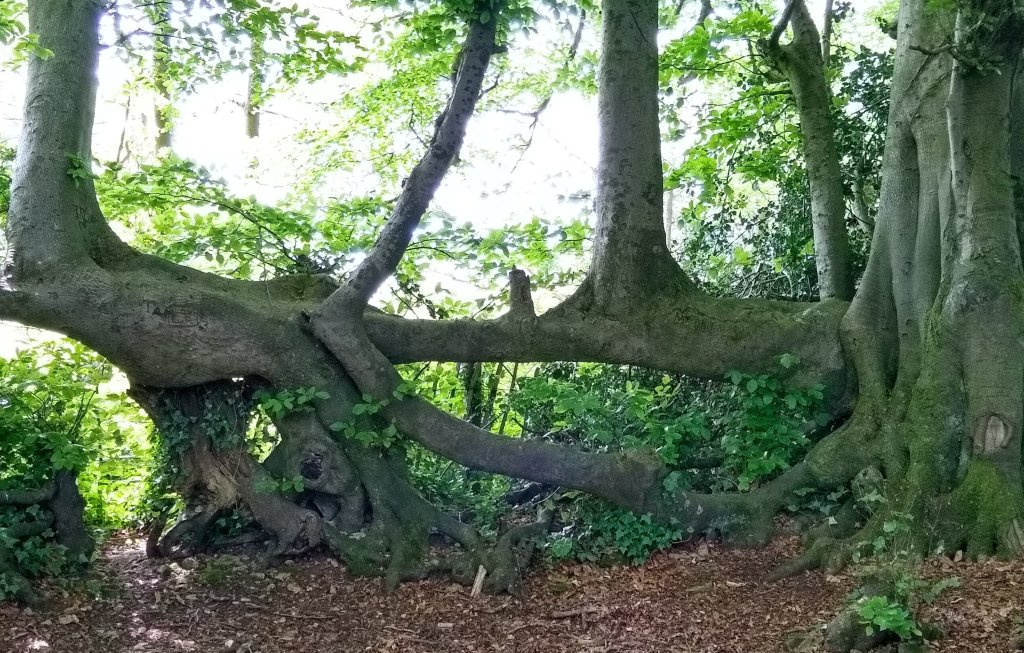
Before I started writing this blog post I took a walk in a nature park that is close to my home. I had spent the morning trying to upload my film to a website in order to submit it to some festivals (more news on that to come), and was in need of a creative reset before I started working on a different project. I frequently find that a walk in a wild place will help me think through what I want to say or do next on any number of my creative works in progress, and it has significant positive impact on my mental and physical health too. I’m not the only one who finds this, and the positive impact of being in green or blue spaces on humans has been established for some time.
This is why I wanted to discuss some of the ideas of Rachel and Stephen Kaplan in this next ‘ideas from science to boost your art’ post. I came across their book, The experience of nature: a Psychological perspective while working up a proposal for a project at work. It’s an old book, published in 1989 and doesn’t appear to be in print any more, but I was able to access it for free here.
The book outlines a theoretical perspective on how natural environments are beneficial to us, and then brings together a lot of evidence to support different parts of the theory from psychological studies that the authors and their students conducted around that time. I really liked how they described an inclusive understanding of natural environments on page 2 as “places near and far, common and unusual, managed and unkempt, big, small and in-between, where plants grow by design, or even despite it.”
I’m not actually going to write about the evidence here. This is partly because the evidence is likely to have been built upon in the thirty years since it’s publication, and should I try to update that here this would turn into a very long blog post. It’s also partly because I think the basic ideas are something that may be helpful and thought provoking to creatives and non creatives alike. Given the book is 368 pages it’s unlikely that I’ll fit everything into a thousand words or so of a blog post, and I have also simplified things because of this. If you like what you see, try giving it a read.
Humans and information
They begin by describing how human beings are highly dependent on information to function, which they hoover up from their environments through all the senses available to them. The brain is in a constant state of sorting through which information is important and requires some sort of action, and which is not. In order to do this hoovering and sorting the brain can engage in two different types of attentional processes:
‘Involuntary attention’ – the kind of focus you may have when engaging with something you already find interesting. This kind of attention is relatively low effort, and enjoyable
‘Directed attention’ – the kind of attention you have to work at. If we think about this as writers, it’s the kind of attention you may need to sustain your concentration through a difficult scene or a series of picky revisions or edits. Sustaining this kind of attention for extended periods of time can result in mental fatigue, even if this has been in the pursuit of a project that is enjoyable.
They then make the argument, which feels intuitively right to me, that in modern society we have constructed urban environments and social structures that constantly provide us with lots of interesting and distracting information, and thus there is lots of ‘sorting’ to do between the information that is just interesting, and the information that requires action. As a result we frequently engage in directed attention, which can result in mental fatigue.
Mental fatigue
For most writers and creatives, especially ones like myself who are trying to fit creative stuff in around other bits of life, I think that mental fatigue may be a familiar feeling. It is the state where someone may feel ‘worn out’ without necessarily having engaged in any physical activity. They even note that people who experience this may complain that they have not engaged in enough activity.
The consequences of mental fatigue may be familiar too. People who are mentally fatigued are more likely to commit human errors and to be aggressive, less tolerant, and less sensitive to socially important cues. So here is the explanation for that gaping plot hole that you didn’t notice first time round in that bit of the book you wrote while really tired and highly caffeinated.
Restorative environments
The bulk of the book is dedicated to building a case around why natural environments may be ‘restorative environments’, by which they mean environments that facilitate rest and recovery from mental fatigue. They cite four different characteristics that environments they consider to be ‘restorative’ have:
The sense of ‘being away’ both from one’s every day concerns and responsibilities, and from noise and cluttered urban spaces
The sense of being in ‘a whole other world’ in which things may look and feel quite different
They are inherently fascinating, and easily engage those processes of ‘involuntary attention’ we met earlier
They are compatible with the things that people like to do
The descriptions of these four types of characteristics are quite long and detailed. I’m not going to paraphrase them here as this blog will never end, and I feel like these characteristics will intuitively make sense to a lot of people. If you do want to read about the detail, the relevant sections start from page 184.
I think many of us can see how being in a natural space may fit the bill for all of the above. Being out in a green or blue space means we are away from our desks, our work places, perhaps even our caring responsibilities, and things feel quite different there. Allowing ourselves the time to pay attention to the plants and insect and other animals can feel like being in a whole other world, and is, for many people, inherently fascinating. Being in calm green places allows many of us to do things that we enjoy, like hiking, cycling or sitting near bodies of water.
Recovery from mental fatigue
The final aspect of this theory that I think is really helpful for creatives is their discussion of how being in a natural environment can help us recover from mental fatigue. They suggest this can happen at four levels:
Clearing the head and allowing your mind to pack away the ‘cognitive leftovers’ from a recent task or project
Recovering our abilities to engage in the processes of directed attention, i.e. our ability to concentrate
The ‘soft fascination’ that is induced by exploring the plants and creatures of a place allows for a kind of cognitive quiet which may give space to think about things that are ignored, or not felt to be important on a day to day level
The space for deeper reflections on one’s life , priorities, actions and goals
For me I think the most important take away from these ideas is that as a creative, the key to being productive and having good ideas is not to work on this or that project in every spare moment as western culture may sometimes suggest. Rather, those moments when we step away from our desks and out, into the garden, or away to the park are really important for our brains to be able to function when we do next sit down to work on something. Personally I found this insight really helpful as I often feel a bit guilty when I take an hour out of my ‘art day’ to walk in the park, and perhapse I don’t need to feel like that at all.
I hope you have found this blog interesting or thought provoking. If you have thoughts or comments, I would love to hear from you.
Thank you for reading. I also write, make art and films. You can read my short fantasy stories here on Simily. If you are interested in the process of creativity and want to get a copy of my free short book of creative prompts, and to hear more about my writing projects please join my mailing list here. You can see my films at my YouTube channel here. You can see things with my designs on at my shop here. Could even treat yourself if you wanted to. Just saying. If buying art is not your thing, but you would like to support what you see I also have a Patreon page here.
One-Time
Monthly
Yearly
Like my work but none of the above options appeal? You could consider a one off donation instead. I would really appreciate it.
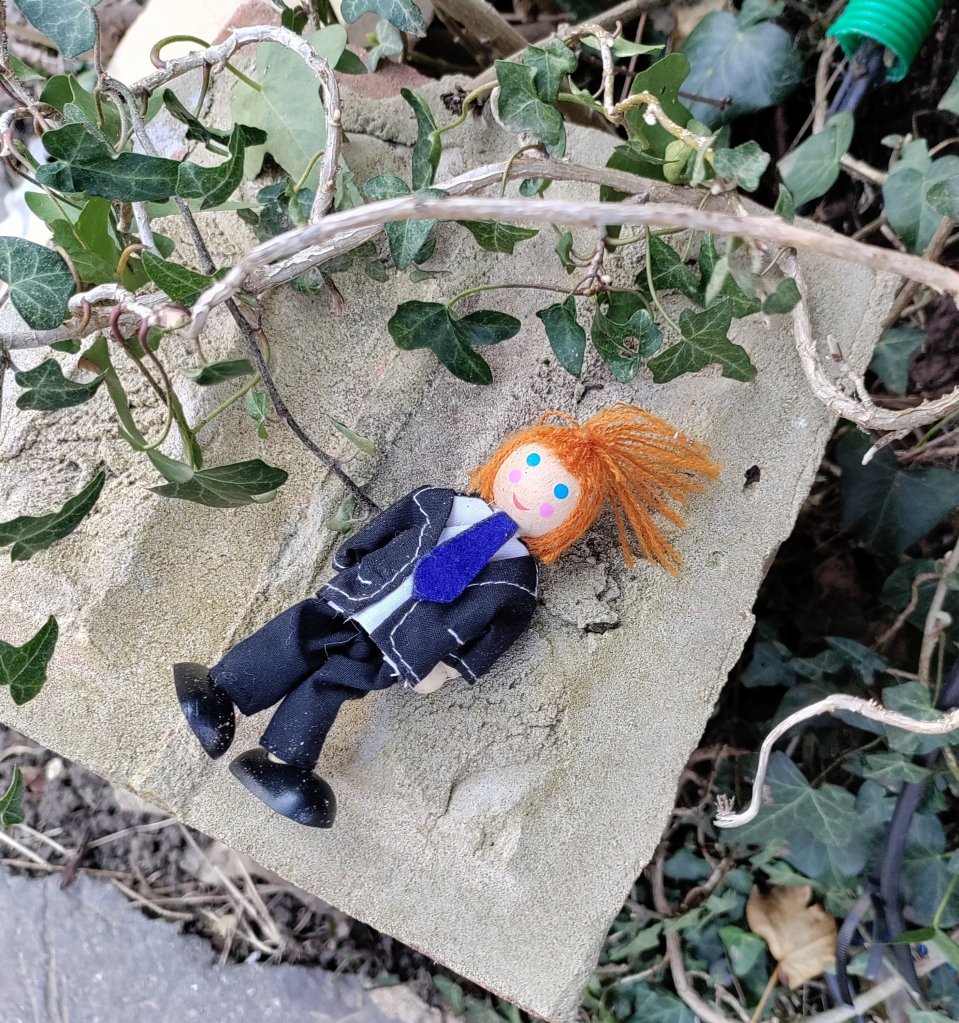
I frequently see ‘lost’ toys and children’s clothes or shoes when I am out and about. I’ve got quite a collection of photographs as there is often something a little forlorn about them, like they are waiting to be reunited with the small being they belong to. Some of those photos feel like they belong on the cover of a mystery novel. But I don’t frequently post them here as most of the time they provoke the same set of thoughts or feelings for me.
However, I took the photo of this particular little doll because it felt different to those other lost toys. The way it is dressed to resemble a someone ready for work or school caught my attention, like it could have been constructed to resemble a specific person. Last night as I was getting ready for bed I began thinking that it looked a little like the kind of artefact someone might produce in order to cast a spell. I’d like to think that the little smile on the face of this doll was placed there to convey a positive intention, perhapse it is a charm to bring luck or fortune in a new job or studies. Or perhapse not.
Who do you think the little doll was made to represent? What may fate or fortune bring them?
I’m not a huge fan of creative exercises, so it’s not my habit to tell people what to do with these prompts. There are lots of options – a scene, some flash fiction, a short story, an idea for a short film or a physical piece of art. If you do have a go with this one and would like to drop the result in the comments please do so. I would be very interested to see what people make of these so please do link to blog posts or comment below.
Thank you for reading. I also write, make art and films. You can read my short fantasy stories here on Simily. If you like these prompts and want to get a copy of a free short book of them I wrote, and to hear more about my writing projects please join my mailing list here. You can see my films at my YouTube channel here. You can see things with my designs on at my shop here. Could even treat yourself if you wanted to. Just saying. If buying art is not your thing, but you would like to support what you see I also have a Patreon Page here.
One-Time
Monthly
Yearly
Like my work but none of the above options appeal? You could consider a one off donation instead. I would really appreciate it.



 The Magpie at Midnight