I’m always intrigued when I see pieces of electronic devices laying around in places that you wouldn’t necessarily expect them. I saw this thing that I’m assuming is a computer chip of somekind (I’m probably wrong here) in a playground when I was out with my son. There were lots of kids running around and using the swings and slides and it seemed out of place, laying there in the dirt.
I’m quite attracted to the green colour and the pattern of lines on the front of the chip. It makes me think that it could encode something interesting, and provokes story ideas for me about a computer savvy child finding a computer chip and getting herself into a strange situation through her own curiosity.
What kind of information could be on this chip?
Where could it lead?
I’m not a huge fan of creative exercises, so it’s not my habit to tell people what to do with these prompts. There are lots of options – a scene, some flash fiction, a short story, an idea for a short film or a physical piece of art. If you do have a go with this one and would like to drop the result in the comments please do so. I would be very interested to see what people make of these so please do link to blog posts or comment below.
Thank you for reading. I also write, make art and films. You can read my short fantasy stories here on Simily. If you like these prompts and want to get a copy of a free short book of them I wrote, and to hear more about my writing projects please join my mailing list here. You can see my films at my YouTube channel here. You can see things with my designs on at my shop here. Could even treat yourself if you wanted to. Just saying. If buying art is not your thing, but you would like to support what you see I also have a Patreon Page here.
One-Time
Monthly
Yearly
Like my work but none of the above options appeal? You could consider a one off donation instead. I would really appreciate it.
In my last blog post from this series I introduced the Transformation-Imagery Theory of narrative persuasion which was developed by Melanie Green and Timothy Brock in the early 2000’s. If you haven’t already read that I suggest you do that here, as what comes below may not make a huge amount of sense without that context.
In this follow on blog I’m going to suggest a few ways in which it can be helpful to writers, especially those who want to create work that has a message that is persuasive, and also to suggest, from the perspective of being a writer, a few ways in which the theory feels like it falls short.
I’m drawing here on the ideas they had when they first described the theory over twenty years ago, so it’s likely that there has been work to refine this since. I will circle back to that at a later date.
How is this helpful to writers?
I think there is some merit in looking at this theory from the perspective of thinking about how to create a story that is highly transporting (of achieving that sense of ‘losing oneself’ in the story for readers).
Green and Brock describe a process that is a meeting between the reader and the story itself, so that while there are important elements in the text that may (or may not!) make it a transporting read, the reader will also bring with them skills, abilities, and previous experiences that will also have an impact on the extent to which they become ‘transported’ into a particular story.
For example, some people may naturally be more skilled at imagining ‘story worlds’ than others, and so are more likely to be transported into any story they read. That said, while there is little we can to to impact on what the reader brings to the reading experience in terms of natural abilities, as writers there are things that we can think about to help them along.
Use of Imagery
While Green and Brock weren’t aiming at giving advice to writers in their early papers (which are the ones I am most familiar with), there are a number of clues for us in the way they framed their theory. In particular they suggested that imagery was key to the experience of transportation, so much so that they included it in the title of their theory.
My interpretation of their writing on this is that the use of language that evokes vivid imagery, interwoven through a clear plot, is key to the experience of transportation, which probably won’t be news to many writers, or indeed readers out there. Many writers will have spent time reading and re-reading passages from particularly well written books, just to try to work out how the author evoked that particular time and space.
But I would be inclined to expand on the idea of imagery to include other sensory information such as taste, smell, temperature and sound. These things don’t seem to feature in the theory, but can be essential in creating the sense of a location in a story. A lot of other better writers than me have written on this topic, but personally I feel that stories that rely on images alone create a story world that feels a little flat, and is not always persuasive.
Emotional involvement
The theory also suggests that stories that evoke strong emotional reactions may be more transporting, although interestingly they don’t really talk about understanding the emotional journey of the characters. Instead they seem to link the emotional responses of readers with the events in the story, i.e. what happens to the characters, and the readers ability to ‘see them’ through imagery.
But if we fill in the gaps here, we can think about stories where characters go on an emotional journey on comparison with stories where this doesn’t happen, and draw our own conclusions on which are more emotionally engaging. For me this feels like a missing link, but luckily for us there is another theory from psychology that can help us here, and I will write about that in my next post.
Adhering to narrative formats
Perhaps of interest to genre writers (like myself) in particular, they pointed out that people often like particular forms of stories (the example they draw on here is the suspense story) and will protect their experiences of it. In today’s money that means avoiding spoilers.
They didn’t go into great detail on this, but it reminded me of conversations I’ve heard else where about breaking, or not breaking your contract with the reader. If you kill a banker on page two, and bring in a detective as a main character on page three, the reader will expect a series of clues, setbacks and revelations until, at the end of the book, they ‘guy who done it’ is caught.
So my interpretation of what they were saying here is, don’t disappoint the reader, or it will damage their experience of the story and reduce likely transportation into it.
Avoiding false notes
One of they things that Green and Brock did explicitly mention as being potentially damaging to the experience of transportation was the existence of ’false notes’ within a story. By this they meant aspects of a story that ‘did not ring true’, they contradicted other aspects of the story or generally didn’t make sense.
While they didn’t mention this specifically, for me false note could refer to those moments where a character does something that simply seems wrong, and that doesn’t fit with the picture you have built up of the character. Something that does not seem to hold emotional truth. I have frequently put down books and stopped watching shows and movies where I like a character and then they suddenly do something that I think is really stupid.
So I think this bit of their work can be particularly helpful at revision time. Is everything consistent? Does everything make sense? Does my fictional story carry emotional truth?
I hope you have found this interesting, in my next post I’m going to move on to some of the work by Keith Oatley about literature providing a kind of emotional simulation. I hope you will follow along if you are interested in these kind of ideas.
Thank you for reading. I also write, make art and films. You can read my short fantasy stories here on Simily. If you are interested in the process of creativity and want to get a copy of my free short book of creative prompts, and to hear more about my writing projects please join my mailing list here. You can see my films at my YouTube channel here. You can see things with my designs on at my shop here. Could even treat yourself if you wanted to. Just saying. If buying art is not your thing, but you would like to support what you see I also have a Patreon page here.
One-Time
Monthly
Yearly
Like my work but none of the above options appeal? You could consider a one off donation instead. I would really appreciate it.
I saw this ring box laying on the floor not far from one of the parks where I like to take my son so he can run around and say hello to the ducks. This little box evokes a sense of mystery for me, it could hold many different stories. The way the box gapes open on the grass, seemingly discarded, and is missing the little cushion that would usually contain the ring provokes a sense of loss or refusal.
Was the ring stolen, and the box discarded as a way of ridding the thief of the evidence?
When I first saw it, many possibilities came to mind:
Did someone buy a ring only to find their gift unwelcome?
Did someone discard the box and it’s contents after finding out that their love had not been true to them?
Was the ring stolen, and the box discarded as a way of ridding the thief of the evidence?
I’m not a huge fan of creative exercises, so it’s not my habit to tell people what to do with these prompts. There are lots of options – a scene, some flash fiction, a short story, an idea for a short film or a physical piece of art. If you do have a go with this one and would like to drop the result in the comments please do so. I would be very interested to see what people make of these so please do link to blog posts or comment below.
Thank you for reading. I also write, make art and films. You can read my short fantasy stories here on Simily. If you like these prompts and want to get a copy of a free short book of them I wrote, and to hear more about my writing projects please join my mailing list here. You can see my films at my YouTube channel here. You can see things with my designs on at my shop here. Could even treat yourself if you wanted to. Just saying. If buying art is not your thing, but you would like to support what you see you could buy me a KoFi, and I also have a Patreon Page.
I have recently been revisiting some of the research I read while I was conducting my PhD over 15 years ago. At the time I was interested in understanding why stories can be more persuasive than facts or reasoned arguments, (which turns out to be quite an evergreen topic in itself – more on that in future posts).
At the moment I have been taking anther look at these things because I am interested, as a writer, in what can be learning from the psychological research on how readers respond to stories, and I thought other writers may be interested too.
I’m going to start with one of the main theories I worked with during my PhD – Transportation-Imagery Theory by Melanie Green and Timothy Brock (published 2000 – the abstract is linked here for anyone with an interest but unfortunately the whole paper is not publicly available).
Why Transportation-Imagery Theory?
The term ‘transportation was first coined by Richard Gerrig in his book Experiencing Narrative Worlds (published in 1993 – available here (Affiliate link), but FYI it is pricey so I suggest you look for it in a local library if you are interested), and later expanded upon by Green and Brock in their peer reviewed paper ‘The role of transportation in the persuasiveness of public narratives’ (published 2000 – the abstract is linked here for anyone with an interest but unfortunately the whole paper is not publicly available).
They were interested in developing a theory about why embedding ideas into narratives can be so persuasive, at times more persuasive than factual information or reasoned arguments. For this reason I think that this theory may have points of interest in it, both for writers who want to convey particular messages in their work, but also perhaps for writers who want to avoid perpetuating harmful messages too.
In our current social and political climate, this kind of thinking feels more, rather than less relevant than it did when I originally started working on my PhD 15 years ago. Whether we intend it or not, most stories contain some kind of message (Gail Carrigers Book, The Heroine’s Journey makes this point very well (Affiliate link)), so it can be helpful for most writers to understand the potential impact their work may have.
What does ‘transportation’ into a story mean?
The idea here should make intuitive sense to anyone who has ever been an avid reader, and has ‘lost themselves’ in a book. It’s that feeling of being transported into a different world, while losing touch with what is happening in your own, of time passing without you noticing as you follow the twists and turns of events happening for the book’s characters. Its that feeling of being able to see and feel and smell the environment that the characters are in, and of reacting to the emotions that the characters feel.
So you may be thinking at this point, we know that this is a thing, do we really need a psychologist to tell us that? The work of researchers in psychology (and basically any other field of study) is to try to describe a phenomenon in a way that allows them to test different theories about how it works. This is the way in which scientists learn how things do, and do not work. What Green and Brock were trying to do was to describe the experience of transportation in a way that would allow them to test the impact of it on readers, and learn more about how it worked from the inside.
In their chapter in the book Narrative Impact (which I am using as my main source for this article – it was published in 2002 and now is available on amazon (affiliate link) here but FYI it is pricey so again, as at your local libarary!) they describe transportation as a “convergent process, where all of the person’s mental systems and capacities become focused on the events occurring in the narrative” (Page 324). This may account for that sense of dislocation one feels when being disturbed when reading a really good story, and of needing to take a moment to ‘come back into the room’.
Their main argument is that the more a person becomes ‘transported’ into a story, the more likely it is that they will find any messages embedded within that narrative to be persuasive, which may even result in changes in attitudes and beliefs.
Why are those messages more persuasive when found in a story?
There are a number of reasons why this process of transportation results in people being more likely to believe messages that are embedded within a story, and many of these reasons draw on the work of other scientists and psychologists. Over the next few months (or possibly years) I’m going to be writing about some of that work so if you are interested in learning more be sure to follow my blog here, or over at Medium if that’s where you prefer to read things.
In brief, some of the reasons why a transported reader may be more persuadable are:
Narratives mimic episodic memory – the kind of memory we use to remember important moments and events in our lives – so can be easier to understand and remember for many people
Processing narrative and stories may be a process that draws on many resources of the brain, as it involves understanding or constructing images, characters, settings and emotions, and more, all weaved together at once – there may not be many resources left to identify and think about messages we receive in this way, let alone form counter arguments to them
Often people engage with stories for the sake of enjoyment or distraction, they don’t go into the experience with the aim of critiquing messages they find there
The experience of transportation results in a kind of psychological distancing from everyday life, meaning that some facts, ideas and other forms of ‘real world’ knowledge that may contradict those messages may be less accessible to transported readers
It’s worth mentioning here that all people are different, and not all brains work in the same way, so the above effects may be more or less prevalent for different people.
I hope you have found this interesting, in Part Two (read here) of this mini-series I will explain some of the insights from this theory that may be helpful (or not!) to the process of writing.
Thank you for reading. I also write, make art and films. You can read my short fantasy stories here on Simily. If you are interested in the process of creativity and want to get a copy of my free short book of creative prompts, and to hear more about my writing projects please join my mailing list here. You can see my films at my YouTube channel here. You can see things with my designs on at my shop here. Could even treat yourself if you wanted to. Just saying. If buying art is not your thing, but you would like to support what you see I also have a Patreon page here.
One-Time
Monthly
Yearly
Like my work but none of the above options appeal? You could consider a one off donation instead. I would really appreciate it.
I’ve been thinking a bit more carefully in the last few weeks about some of the settings and locations in my fantasy novel series (working title Feeding Jasmine Valentine). I’m in the middle of a new re-write at the moment and have a chance to go back and really think about what I may need to build on the first draft, and how some of the key locations can be more useful in the narrative if I do some more substantial world building around them.
I’m quite a visual person (which may be a Dyslexic thing) and having pictures and diagrams tends to help me, so I spent an hour one afternoon last week on some ‘first take’ sketches of a key location in the first book. There are bound to be problems with my initial ideas, and I’m going to work on these a bit more, but I thought it may be nice to share my first messy sketch here, if only to show I’m still working on it!
I’d be really interested to hear from other writers who use sketches in their world building. How do you do that? Do you think it’s really useful or a form of procrastination?
Thank you for reading. I also write, make art and films. You can read my short fantasy stories here on Simily. If you are interested in the process of creativity and want to get a copy of my free short book of creative prompts, and to hear more about my writing projects please join my mailing list here. You can see my films at my YouTube channel here. You can see things with my designs on at my shop here. Could even treat yourself if you wanted to. Just saying. If buying art is not your thing, but you would like to support what you see I also have a Patreon page here.
One-Time
Monthly
Yearly
Like my work but none of the above options appeal? You could consider a one off donation instead. I would really appreciate it.
I saw this broom leaning against this tree the other morning and decided to take a photograph because i liked the design of the bristles. I tried a few different angles but couldn’t really get a great shot of them, although in this one you can see how they are bound together with different coloured threads of some kind. Close up the bristles were quite intricately arranged and this detail appealed to me.
I didn’t see anyone around, all the nearby shops were closed and I didn’t see any evidence of a huge mess that needed cleaning up. However the shops close by are all small independent shops, including a post office and a chicken take away, and I could imagine one of the shop keepers wearily resting the broom against the tree before they closed up for the night. It felt to me like quite a nice jumping off point for a character study, so I thought I would post it here.
Who do you think was sweeping up in the evening? What kind of mess did they need to clean up (ordinary, or emotional)?
I’m not a huge fan of creative exercises, so it’s not my habit to tell people what to do with these prompts. There are lots of options – a scene, some flash fiction, a short story, an idea for a short film or a physical piece of art. If you do have a go with this one and would like to drop the result in the comments please do so. I would be very interested to see what people make of these so please do link to blog posts or comment below.
Thank you for reading. I also write, make art and films. You can read my short fantasy stories here on Simily. If you like these prompts and want to get a copy of a free short book of them I wrote, and to hear more about my writing projects please join my mailing list here. You can see my films at my YouTube channel here. You can see things with my designs on at my shop here. Could even treat yourself if you wanted to. Just saying. If buying art is not your thing, but you would like to support what you see I also have a Patreon Page here.
One-Time
Monthly
Yearly
Like my work but none of the above options appeal? You could consider a one off donation instead. I would really appreciate it.
We’ve had a couple of days of sun and I’ve been trying to get out to some slightly further flung spots around the area that I live than usual when I walk. This is another picture from the edge of a railway line, where I saw this wheel poking out from under the fence.
I really liked the juxtaposition of the wheel, which may be from a pram or a trolly, and the empty whisky bottle. There is a story in the image, the wheels coming off a situation, and perhaps as a consequence some commiserations aided by hard liquor.
What do you think could have happened here? What was the consequence?
I’m not a huge fan of creative exercises, so it’s not my habit to tell people what to do with these prompts. There are lots of options – a scene, some flash fiction, a short story, an idea for a short film or a physical piece of art. If you do have a go with this one and would like to drop the result in the comments please do so. I would be very interested to see what people make of these so please do link to blog posts or comment below.
Thank you for reading. I also write, make art and films. You can read my short fantasy stories here on Simily. If you like these prompts and want to get a copy of a free short book of them I wrote, and to hear more about my writing projects please join my mailing list here. You can see my films at my YouTube channel here. You can see things with my designs on at my shop here. Could even treat yourself if you wanted to. Just saying. If buying art is not your thing, but you would like to support what you see you could buy me a KoFi, and I also have a Patreon
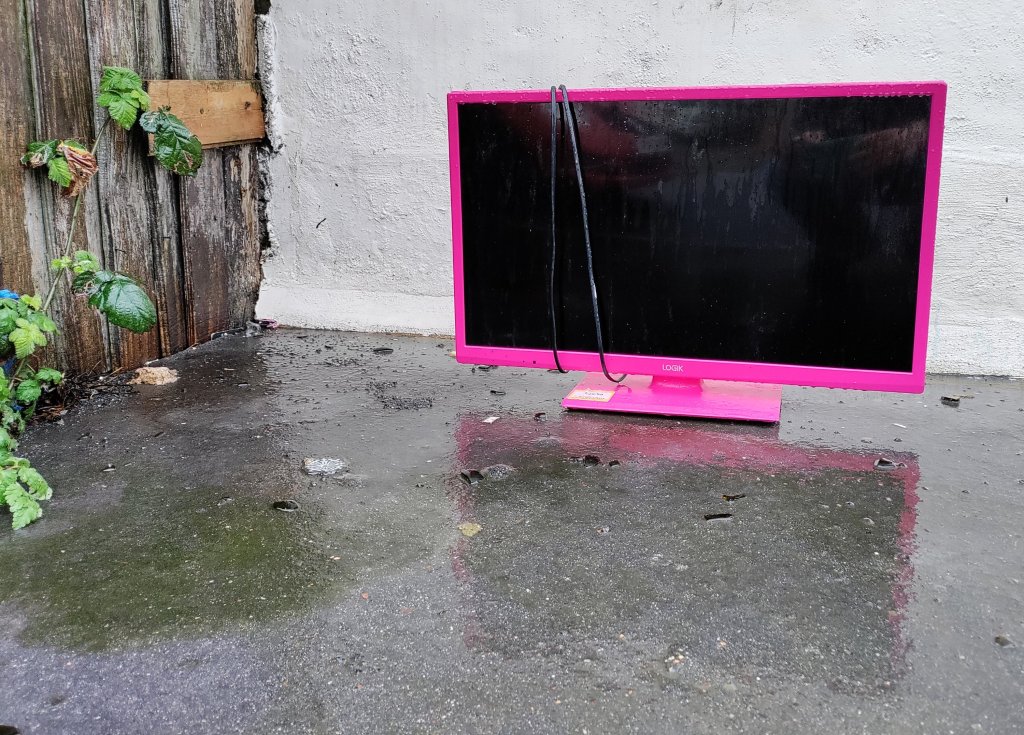
It had been raining for several hours when I saw this telly on the pavement. I was particularly attracted to the cheerful pink casing and stopped in the rain to take the photo. It was a bit difficult at the time to see what I was taking on the small screen of my phone because I was trying to keep it out of the rain. At the time I didn’t realise that I had captured the reflection of the telly on the wet pavement, so that was a nice surprise when I looked back at the photo to include it here.
It got me thinking a bit about how we don’t always see everything that is there in front of us. If we think about applying this to a character or a physical location in a story this opens the door to great narrative potential.
A stranger is charming and beautiful, but what secrets do they try to hide?
The hotel is elegant. That staff are attentive and professional. There is an elaborate glass chandelier in the entrance hall and the food is excellent. But why is there a locked door on the second floor without a room number, and what is behind it?
I’m not a huge fan of creative exercises, so it’s not my habit to tell people what to do with these prompts. There are lots of options – a scene, some flash fiction, a short story, an idea for a short film or a physical piece of art. If you do have a go with this one and would like to drop the result in the comments please do so. I would be very interested to see what people make of these so please do link to blog posts or comment below.
Thank you for reading. I also write, make art and films. You can read my short fantasy stories here on Simily. If you like these prompts and want to get a copy of a free short book of them I wrote, and to hear more about my writing projects please join my mailing list here. You can see my films at my YouTube channel here. You can see things with my designs on at my shop here. Could even treat yourself if you wanted to. Just saying. If buying art is not your thing, but you would like to support what you see you could buy me a KoFi, and I also havea Patreon Page.
When I started writing this post I had an idea that I would post it as part of my series about ideas from science that may be helpful to creative folks to know. However, as I was writing it I realised that my take on it was probably going to be a little more personal than I had in mind of that series, so I think it needs to stand a little away from that, although it will still be of interest to people who like those posts, I hope.
So here’s where it gets a bit personal. Up until the age of about 9 or 10, I couldn’t really read or write. I think I must have been pretty good at the performance of reading or writing because people (by which I mean teachers) didn’t seem to notice, but unfortunately for me, the products of these performances were not intelligible to anyone but myself.
Back in the 1980’s I don’t think dyslexia was a well understood thing in small country schools in the UK. My father has told me that it was at a parent’s evening, where a teacher had already told him that I was ‘doing fine’, where he encountered some of my writing that was so confusing that he determined that things definitely weren’t ‘fine’, at all.
I was lucky enough to have parents who understood that I was clever enough to be able to do these things, but some how I couldn’t, and I was luckier still that they could afford to employ a tutor to work with me on school evenings (apparently only acceptable to 9 year old me because he wore a leather coat and had an earring).
By the time I got to secondary school a year or two later, I could read and write well enough to keep up in most classes. In English however I was still considered to have a learning disability, and received the kind of ‘support’ that was effective in demonstrating to my peers there was something wrong with me, but not effective in actually helping with the problem as it focused on poor spelling.
Now we all have autocorrect in our word processing programmes, no one needs to be able to spell perfectly, but back then it was considered a big thing. So much so in fact, that any creative abilities in writing seemed to take a back seat to things like spelling, and I ended up feeling like science was a much better fit for me than the arts and humanities (our art department wasn’t exactly an embarrassment of riches either).
I wasn’t actually formally diagnosed with dyslexia until after I’d been in university for a year, and since then I’ve not done a huge amount of research into it, which is curious because it would probably have helped me understand myself better. Since that time I’ve been more and more drawn to creative projects, and have taken classes and taught myself all sorts of creative things while still keeping one foot in the sciences, and never quite settling to ‘specialise’ in anything, which probably hasn’t helped my career really. When I saw this paper I thought maybe the science on dyslexia can help me play to my strengths a bit better.
What we now know about dyslexia
According to the paper, dyslexia is a ‘visual processing defect’ with an impact on literacy skills, and there are issues in sustaining vital attention which fits quite well with my experience.
Where it is spoken about publicly, it is typically discussed or written about as a disability or a problem, and in the mind of the public probably equates to ‘people who can’t read or write well.’ The central idea of the research paper, ‘Not all those who wander are lost’ is that dyslexia is not only a problem, it is also a strength, and not just a single strength, but many.
While I had been aware of the links between creativity and dyslexia for a while, I was surprised by the raft of things cited just in the introduction of this paper that people with dyslexia are good at (by which I mean better than the average person without dyslexia). This list of things both filled in some blanks for me about my personal experience, and pointed in the direction of what I may want to read next.
Here some of the things that the paper mentioned that people with dyslexia are better at, which resonated with my own experiences (and does not at all cover everything said there):
Better accuracy in processing three dimensional information – this includes being able to complete tasks that involve visual spatial skills such as drawing, mechanical puzzles and building models more easily. One of the things that really stuck out for me was the suggestion that we can be alert to lots of information at once, including detecting anomalies and being sensitive to changes in the environment. I’ve noticed that I tend to be very distractible, and don’t exactly flourish in open plan offices, and tend to be pulled in quite easily to ‘things’ that are going on, so this tracks for me. I also began to think that maybe there is a story there about an agency of dyslexic spies!
Interconnected reasoning – we can bring together many sources of information, some of which may be unexpected and make connections between things that may not occur to people with more typical brains
Narrative reasoning – apparently we have better abilities to remember information that is embedded in story, and it is common for people with dyslexia to enjoy creative writing despite difficulties they may have with writing.
Problem solvers – people with dyslexia can be good at problem solving as they are more likely to draw on ideas from different, sometimes unconnected, places. There is a high incidence of dyslexia in entrepreneurs, which I found kind of interesting.
Big picture thinkers – this may also relate to the way people with dyslexia connect different sources of information in ways that people without it may not, leading them to think ‘out of the box’. As I hinted at above, in my own day job career I’ve found myself roaming around research areas (including psychology, ethics, epilepsy, learning disability, mental health and more general social sciency stuff), rather than ever truly settling on one thing, and never quite fit into the academic mold that rewards people who dive deeply into one thing. My magpie brain is constantly picking up on new things it perceives as shiny.
Creativity – this wasn’t a surprise for me as I’m seem unable to comfortably stick to one medium, and am constantly picking up new creative projects
Unexpected (for me) skills:
Empathy – in my day job I have ended up in an area that really requires good interpersonal skills. It didn’t really occur to me that these softer skills may be a dyslexic thing, and that may relate to the way that the public story of dyslexia has been about difficulties with reading and writing!
Networking and team building – This is also something I found surprising. In person I am quite good at working in a team and do like to talk to people and network, but I’m actually finding these things quite difficult to do in the world of remote working and zoom calls, and wonder if this relates to the whole ‘good at processing information in 3D space’ thing, because the flattening of the world through a zoom screen has had the effect of flattening me too.
Memory and memory recognition tasks – I’ve always felt I had a terrible memory – and I do for names and dates, but actually not really for other things. It’s more that I doubt my memory and find myself checking even when I’ve remembers correctly – my narrative recall is good, as would be predicted by this work.
I realise at this point that I’ve not really talked about what this group of researchers actually did in their own research – I think I will leave that for a part two of this post as it’s already rather long.
I hope that this has been interesting for dyslexics and non dyslexics alike. If you are a dyslexic writer like me, let me know in the comments – do any of these things match your experiences too?
Thank you for reading. I also write, make art and films. You can read my short fantasy stories here on Simily. If you like these prompts and want to get a copy of a free short book of them I wrote, and to hear more about my writing projects please join my mailing list here. You can see my films at my YouTube channel here. You can see things with my designs on at my shop here. Could even treat yourself if you wanted to. Just saying. If buying art is not your thing, but you would like to support what you see you could buy me a KoFi, and I also have a Patreon Page.
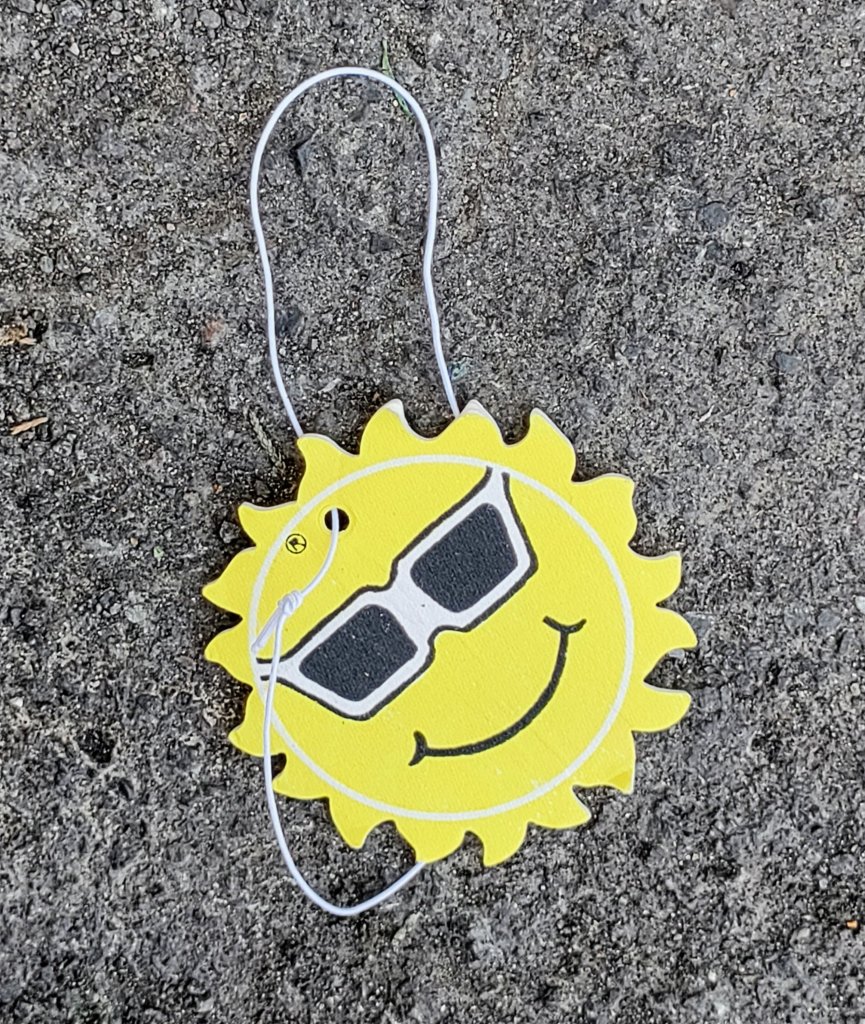
I saw this little guy in the road a few weeks ago. The sun was shining for what felt like the first time this year and it felt nice to be out and about. I chose this photo in particular because it represents a dichotomy for me, and also speaks to how creativity acts through our own biases and experiences.
I really like the cheerful face on the air freshner, but in general I avoid all air freshners (and most commersial perfumes) as they contain some kind of chemical that makes me feel really sick.
Some of the best stories I’ve read and films or TV shows I’ve seen have been about situations that appear to be calm and picturesque, while just below surface there are hints that all is not as it should be.
What situations or people can you think of that may appear to be one thing, while actually being another?
I’m not a huge fan of creative exercises, so it’s not my habit to tell people what to do with these prompts. There are lots of options – a scene, some flash fiction, a short story, an idea for a short film or a physical piece of art. If you do have a go with this one and would like to drop the result in the comments please do so. I would be very interested to see what people make of these so please do link to blog posts or comment below.
Thank you for reading. I also write, make art and films. You can read my short fantasy stories here on Simily. If you like these prompts and want to get a copy of a free short book of them I wrote, and to hear more about my writing projects please join my mailing list here. You can see my films at my YouTube channel here. You can see things with my designs on at my shop here. Could even treat yourself if you wanted to. Just saying. If buying art is not your thing, but you would like to support what you see you could buy me a KoFi, and I also have a Patreon Page.



 The Magpie at Midnight