I’m getting to slow to walk about as much as I was, so my street photography opportunities are limited at the moment, but I have been finding other things to take photographs of. I’m aware I’m not posting consistently now, I’m just too tired. Hopefully I’ll get some of my creative energy back in the weeks after they arrive.
We’ve recently been doing a bit of decorating in our house. I’ve hit the point in my pregnancy where ‘heavy’ is the only appropriate descriptor for me, so I’ve not actually been doing the work, but various relatives have been arriving at the house to strip wall paper and entertain my toddler. I am greatful for all of that help.
Recently we removed layers of wall paper in our hallway of a colour scheme too hideous to take photographs of, and underneath it we found this. It’s the ghostly imprint of a previous generation of wallpaper on the plaster, although none of the actual wallpaper remained under the current woodchip.
I live in the UK and have been involved in decorating a number of old houses in my time. Often peeling back layers of wallpaper reveals yet older layers beneath, and it is sometimes sad to have to strip back the history of a place to be able to paint and clean things up.
I often wonder about the people who choose the ancient styles of wallpaper, who they were and what there lives may have been like. They put me in mind of the kind of ghost stories that are set in old, secluded country houses.
The pattern here is floral, and given the way it left an imprint on the plaster it must have been strongly textured. I imagine it was good quality paper, maybe bought by people who hoped to give a good impression to their neighbours.
Who do you think choose the wall paper?
What happened to them?
If these walls could talk, what stories would they tell us?
I’m not a huge fan of creative exercises, so it’s not my habit to tell people what to do with these prompts. There are lots of options – a scene, some flash fiction, a short story, an idea for a short film or a physical piece of art. If you do have a go with this one and would like to drop the result in the comments please do so. I would be very interested to see what people make of these so please do link to blog posts or comment below.
Thank you for reading. I also write, make art and films. You can read my short fantasy stories here on Simily. If you like these prompts and want to get a copy of a free short book of them I wrote, and to hear more about my writing projects please join my mailing list here. You can see my films at my YouTube channel here. You can see things with my designs on at my shop here. Could even treat yourself if you wanted to. Just saying. If buying art is not your thing, but you would like to support what you see you could buy me a KoFi, and I also have a Patreon Page.
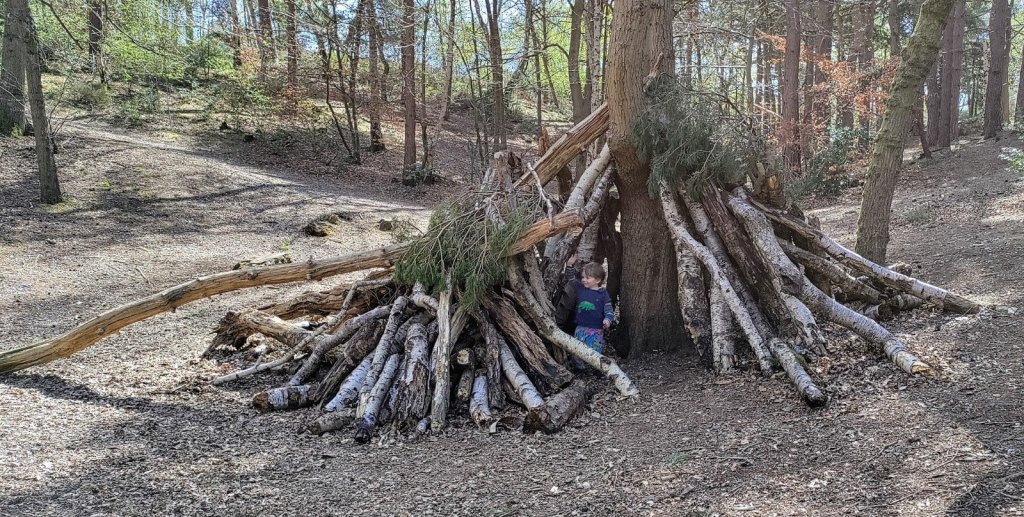
I’ve had this photograph sitting on my computer for more than six months. It’s of a den my partner and I found in the woods while we were out with my son in the summer. At the time I found it enchanting, as I always do when I find these secret places that so strongly remind me of childhood.
I don’t normally like to put photos of my son out on social media, mostly because I feel he’s too young to understand what it means and so too young to ask permission from. But you can’t see his features in this photo, and he has changed a lot since then anyway. It’s helpful to have a little figure in the picture to get the scale of the thing.
Later in the summer a wild fire swept through the entire area where we saw this little den. We’ve not been back since it happened so I do not know if it survived the blaze.
I’m writing this as we prepare for Christmas, another time that is intimately bound up with the excitements and disappointments of childhood. The picture reminds me that some of the most alluring mysteries of childhood, some of the things that may make the best fuel for a good story, are fleeting, and rapidly lost to time and events beyond our control.
Who do you think built this hideaway?
How did they build it and why?
I’m not a huge fan of creative exercises, so it’s not my habit to tell people what to do with these prompts. There are lots of options – a scene, some flash fiction, a short story, an idea for a short film or a physical piece of art. If you do have a go with this one and would like to drop the result in the comments please do so. I would be very interested to see what people make of these so please do link to blog posts or comment below.
Thank you for reading. I also write, make art and films. You can read my short fantasy stories here on Simily. If you like these prompts and want to get a copy of a free short book of them I wrote, and to hear more about my writing projects please join my mailing list here. You can see my films at my YouTube channel here. You can see things with my designs on at my shop here. Could even treat yourself if you wanted to. Just saying. If buying art is not your thing, but you would like to support what you see you could buy me a KoFi, and I also have a Patreon Page.
I frequently see lost things belonging to children when I’m out and about. It’s probably because my life mostly revolves around activities for toddlers and home working that I end up in places where lost shoes and lost toys accumulate.
I always think there is something a little forlorn about a tiny lost trainer on the pavement, but at the same time I see these objects so frequently that I seldom stop to photograph them these days.
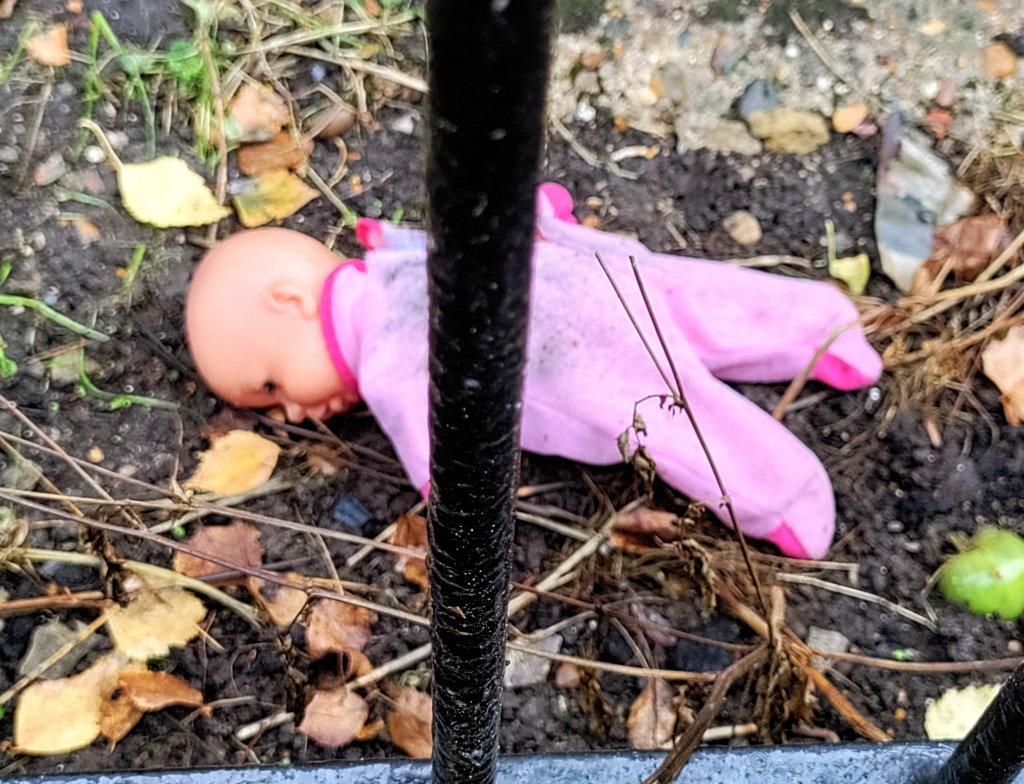
I actually saw this doll on one of the few days I’ve had recently that didn’t revolve around entertaining a toddler. I was walking from the train station to the physical office where I used to be based all the time, but now only visist about twice a month on a hybrid working arrangement.
This doll was laying face down on the floor near a block of flats, I imagine forgotten after a hard day of playing. I stopped for this photograph because for me there is something a little sinister about the way it is positioned, and how the doll is face down in the dirt.
When I went to look closely at the photograph I found that face to the doll is out of focus, despite my best intentions to get the eyes, and that only adds to the sinister appeal.
It reminds me of the set up of a lot of those serial crime shows that were popular in the early 2000’s like CSI and Criminal Minds. Maybe the loss of the doll is the beginning of a thriller type story.
How did the doll come to lay there like that?
Who did it belond to?
Where are they now?
I’m not a huge fan of creative exercises, so it’s not my habit to tell people what to do with these prompts. There are lots of options – a scene, some flash fiction, a short story, an idea for a short film or a physical piece of art. If you do have a go with this one and would like to drop the result in the comments please do so. I would be very interested to see what people make of these so please do link to blog posts or comment below.
Thank you for reading. I also write, make art and films. You can read my short fantasy stories here on Simily. If you like these prompts and want to get a copy of a free short book of them I wrote, and to hear more about my writing projects please join my mailing list here. You can see my films at my YouTube channel here. You can see things with my designs on at my shop here. Could even treat yourself if you wanted to. Just saying. If buying art is not your thing, but you would like to support what you see you could buy me a KoFi, and I also have a Patreon Page.
When I first came across the work of James Pennebaker during my PhD studies, I was pretty inspired by it. His initial idea was that writing about personal traumas over a period of time could help people process them and begin to heal. This theory came from an observation, made by many different scholars and thinkers over time, that keeping secrets is stressful, and that humans appear to have an innate need to confess.
The nature of the way society often talks about trauma and mental health challenges means that those who experience them often feel intense shame or stigma around their struggles. While this situation appears to finally be improving, for many people shame has been a hefty barrier to talking about what has happened to them for a long time. For example we are only now beginning to understand the sheer scale of the abuse that happens to children because many who experienced it have felt forced into silence for so long.
James Pennebaker had the idea that if people were able to write about their experiences, a practice her called ‘expressive writing’, this may form part of a process that would allow people to process what had happened to them and begin to heal. One of the advantages of expressive writing is that it’s possible to do this in private, or to share it with people you trust, either way you have control over who sees it.
What is expressive writing?
In their book, Opening Up by Writing it Down (affiliate links – if you use these links to make a purchase I’ll get a tiny commission), James Pennebaker and Joshua Smyth describe expressive writing as “a technique where people typically write about an upsetting experience for 15-20 minutes for three to four days (Pg. ix).”
They are not prescriptive on the number of days, or the time spent writing each day, and actively encourage people who are interested in this practice to experiment with what works for them personally. They suggest that this kind of writing exercise allow people to spend time gaining a better understanding about the feelings that have about what has happened to them.
What is the theory behind it?
Pennebaker and Smyth note that having traumatic experiences is bad for your health, and suggest that some traumas may have more insidious effects than others because the nature of them, as I suggested above, means that people feel unable to discuss these important personal experiences.
They describe keeping “major secrets” as stressful, having a numerous negative biological and psychological impacts including reducing immune function, impairing the work of the cardio-vascular system, agitating the nervous system and even impacting on the chemistry in our brains. Sustained over long periods of time these effects can lead to physical illness and mental distress.
By contrast finding a way to release or confess secrets, particularly ones that are difficult or upsetting, can relieve the pressure on our bodies and minds and help reduce both distress and physical illness. Expressive writing may be one way of releasing those secrets.
Evidence
Pennebaker first described his technique in 1986, and in the time since then has conducted a vast programme of research with hundreds of research participants. In his early studies he asked college students to write about traumatic experiences for four days in a row, and he found the following effects:
Immediately after the writing exercises the students reported increased feelings of sadness and anxiety
Over the long term students who had completed the writing exercises reported few visits to the student health centre than control groups of students who had written about non-traumatic subjects
Students who had completed the writing exercises also reported feeling a greater sense of value and meaning
Since those early studies Pennebaker and Smyth have conducted a range of experiments on expressive writing with a wide range of people and have found positive impacts on numerous physical and psychological health markers and conditions, including:
Enhance immune function, including in some people with HIV
Lower blood pressure after expressive writing
Improvements in lung health in people with asthma
Improvements in joint health in people with arthritis
Improved wound healing
Improved quality of life in cancer patients
Improvements in symptoms of depression and PTSD
Who does it not work for?
After seeing some of the evidence it seems like expressive writing could be a easy and cost effective technique to help anyone. However there are some people who the technique appears to have little impact on.
Some of the studies that Pennebaker and a range of colleagues conducted suggested that expressive writing was most useful to people who did not have other opportunities to disclose, suggesting that for people who do have those opportunities may feel little benefit.
I have also read elsewhere (and apologies as I cannot remember the source) that people themselves writing almost the same account of a traumatic event over and over, rather than seeing their accounts evolve over time, may receive little benefit, and may even find writing about their traumas harmful. It is possible for people to become ‘stuck’ in their story, rather than evolving through it. For many individuals a skilled therapist will be able to help them gain a better understanding of their feelings about what has happened to them where they may struggle on their own.
Further reading
If you are interested in learning more about expressive writing I recommend you read Opening Up by Writing it Down (affiliate links – if you use these links to make a purchase I’ll get a tiny commission), James Pennebaker and Joshua Smyth. It contains detailed information about the research they have conducted, along with practical writing exercises that you can try. I also find written in a clear and approachable style.
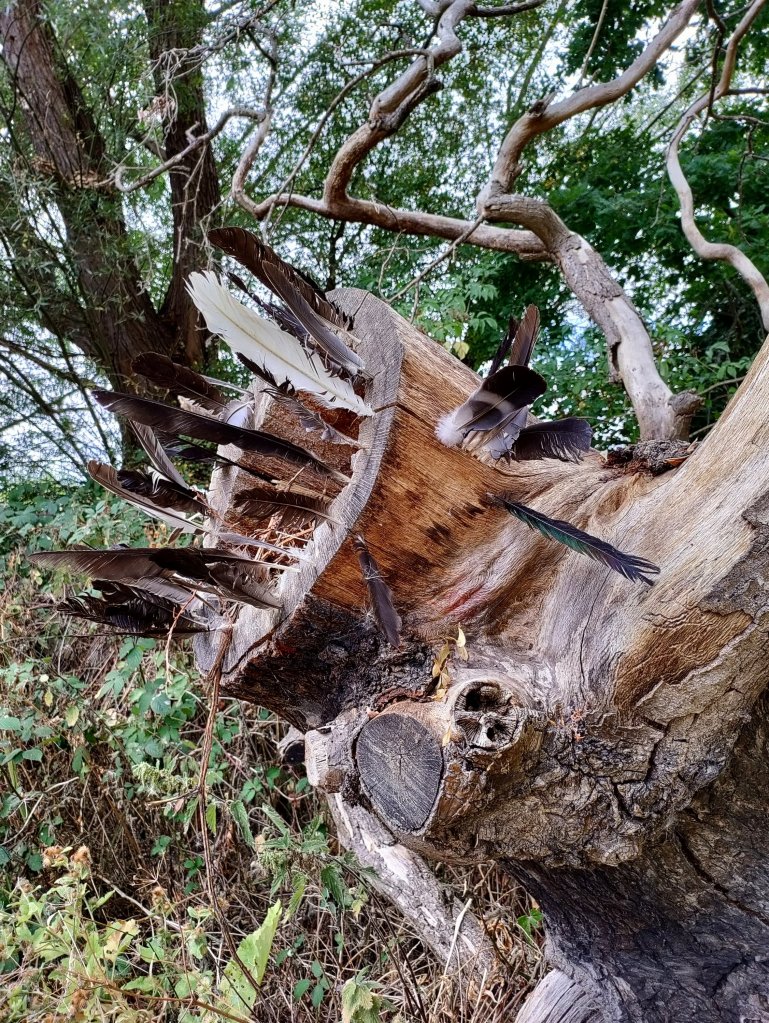
I saw this in our local nature park while walking back from the shops with my son. A few years before and oak tree had fallen across the path and for a while we had the experience of walking under an archway made of the body of the oak tree, until the parts that crossed the path were taken down by the local council.
The stump here is what is left of the oak tree, but until recently I had not seen it adorned like this. I do not know what this means, if it is simply decorative, or is it a symbol or the result of a ritual performed by someone whos spirituality is closely connected to nature.
Of course I do not know what the symbolism here is, or if these are just the efforts of bored teenagers. I did feel that there was something a little strange about it as I walked past, as if it were meant to represent something, or even warn of something.
Who do you think made this strange pattern?
What do you think they were trying to say?
I’m not a huge fan of creative exercises, so it’s not my habit to tell people what to do with these prompts. There are lots of options – a scene, some flash fiction, a short story, an idea for a short film or a physical piece of art. If you do have a go with this one and would like to drop the result in the comments please do so. I would be very interested to see what people make of these so please do link to blog posts or comment below.
Thank you for reading. I also write, make art and films. You can read my short fantasy stories here on Simily. If you like these prompts and want to get a copy of a free short book of them I wrote, and to hear more about my writing projects please join my mailing list here. You can see my films at my YouTube channel here. You can see things with my designs on at my shop here. Could even treat yourself if you wanted to. Just saying. If buying art is not your thing, but you would like to support what you see you could buy me a KoFi, and I also have a Patreon Page.
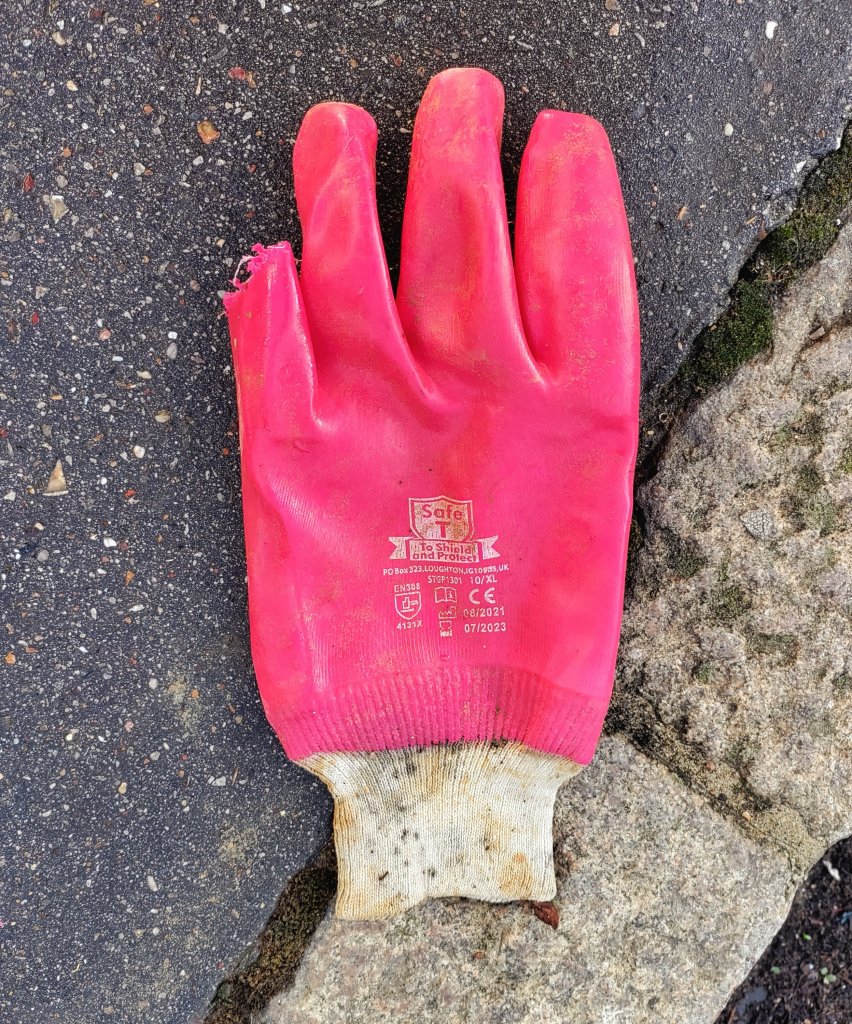
I saw this glove this morning on the pavement as I walked my son to the nursery. It had rained over night and most of the pavement was dark and damp.
The contrast of the bright pink against the grey concrete caught my eye and I stopped to take a photo. As I was standing there with my phone, I noticed that the glove was missing a finger, which I found intriguing.
How did the owner of the glove lose a finger?
Was it just the glove, or the flesh beneath?
Did they lose a finger to a dog, or even a wolf?
I’m not a huge fan of creative exercises, so it’s not my habit to tell people what to do with these prompts. There are lots of options – a scene, some flash fiction, a short story, an idea for a short film or a physical piece of art. If you do have a go with this one and would like to drop the result in the comments please do so. I would be very interested to see what people make of these so please do link to blog posts or comment below.
Thank you for reading. I also write, make art and films. You can read my short fantasy stories here on Simily. If you like these prompts and want to get a copy of a free short book of them I wrote, and to hear more about my writing projects please join my mailing list here. You can see my films at my YouTube channel here. You can see things with my designs on at my shop here. Could even treat yourself if you wanted to. Just saying. If buying art is not your thing, but you would like to support what you see you could buy me a KoFi, and I also have a Patreon Page.
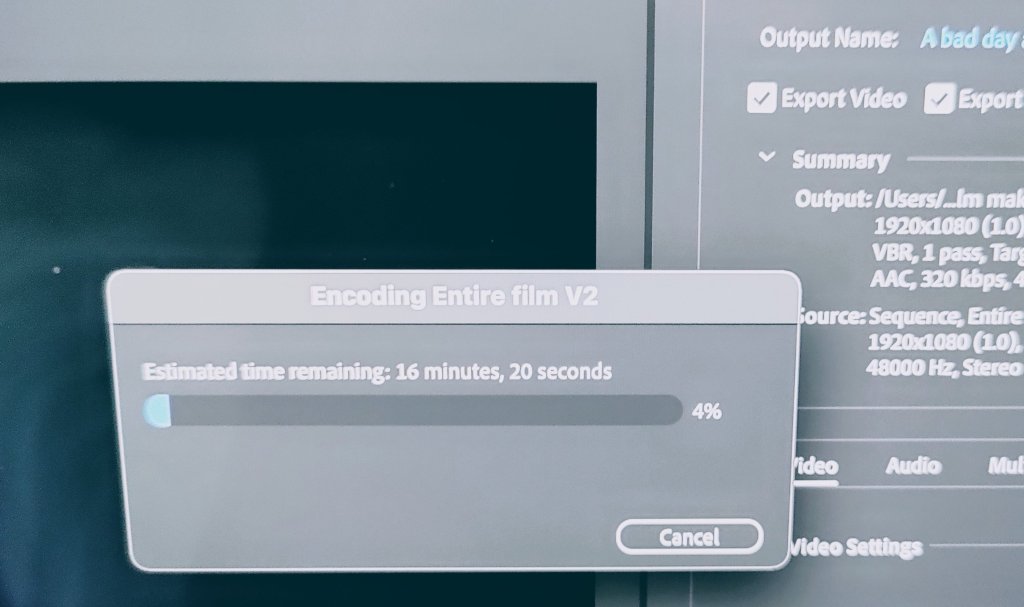
Earlier this year I finally pressed the ‘export’ button on a documentary film I had been making for over 7 years. I ended up working on the project on my own, in my spare time around a full time job, and later 2 house moves and a new baby.
It started out as a project that I did as part of a documentary film making course, which was a six month long part time course. I was meant to produce something that was fifteen minutes long and based only on filmed footage, but what I ended up producing, 7 years later stretches to just over an hour and has numerous animated sequences, which I also produced myself.
The finished film is very much a DIY affair, and is entirely self funded (although after paying for training and buying new equipment I estimate my spending on it to come in under £10,000).
It is the story of a man who was a journalist in Iraq at the beginning of the war in 2003, and who lost part of his leg to a landmine. My aim in the film was to tell the story of this event and his recovery from it.
I’ve entered it into a few festivals but have been knocked back from the bigger ones where I was probably competing against professional outfits. I’m still wiating to hear from some smaller ones, but I don’t really mind this, as entering the film into festivals weas more of a mark of completing the project for me than anything else. For those who know me actually finishing projects isn’t my strong point.
I’m pleased enough with the look, but having made it once there are things I would do differently now. There are definitely a lot of things I learned both about film making and my own creative process along the way.
Technical skills matter
One of the big frustrations I had with that original course is that the tutor spent far more time on ‘ideas development’ than she did on technical skills training. I think that ideas development is really important, and allowing space for that activity is definitely key to a successful project.
However, when I came to try to put some of my ideas into practice I found that I didn’t have the technical skills to do some of the things I wanted to do. Some of those things were quite basic editing techniques, and I needed to go off and pay for more training to really be able to start putting my ideas into practice
Equipment matters
Another problem I had with that orginal course was that the equipment they supplied was very big, clumbersome, and almost impossible to manage on my own. Most of the cameras were really designed for use on sets or bigger productions, not for the DIY documentarian.
I think they intended for groups of students to team up while making their films, but this didn’t work so well on a part time course as we all had different schedules and commitments. The impact this had on me was to make me feel that documentary film making would be inaccessible to me, and to lose courage. But over time I learned this was not the case.
Later I invested in a small digital DSLR camera that records really nice interview footage, a pair of radio mics and some other small bits and pieces. All of this equipement fits in a bag that I can take on the bus with me if I need to.
There are draw backs, in that the DSLR doesn’t like to record footage while it is moving (although it does a nice job with capturing things if it is locked off on a tripod), so I’ll have to supplement my kit at some point with a go pro or a camcorder.
But the lesson here was that with a bit of research I was able to find some kit that worked for me.
Being ‘slow’ is baked into my process
I was reading an article by Dad on the Spectrum the other day on Medium about how people who are neurodiverse take more time to do things. I left a comment about how I used to think I was ‘slow’, but now I know that I just think differently. I think in the comment this ‘slow’ came across as a negative thing, and it probably was at some point in the past.
Now I see that my process of circling through projects and giving each one a rest to breathe for periods of time is probably just part of my process. It certainly slows down my progress, but I think the end results are better so I’m learning to embrace ‘slow’.
I like to make things hard for myself
One of the decisions I made early on was to animate a number of sections in the film. I learned that using film footage is a lot quicker and easier, although maybe less satisfying.
I don’t regret choosing this path, but it was time consuming, labour intensive, and slowed down the whole process even more as I needed to do more training, and learn how to use a different set of software. Still I am glad that I did this as it enriched the experience of making my film.
If after all of that you would like to view the finished film you can see it here.
Thank you for reading. I also write, make art and films. You can read my short fantasy stories here on Simily. If you are interested in the process of creativity and want to get a copy of my free short book of creative prompts, and to hear more about my writing projects please join my mailing list here. You can see my films at my YouTube channel here. You can see things with my designs on at my shop here. Could even treat yourself if you wanted to. Just saying. If buying art is not your thing, but you would like to support what you see I also have a Patreon page here.
One-Time
Monthly
Yearly
Like my work but none of the above options appeal? You could consider a one off donation instead. I would really appreciate it.
I spied these beads the other morning while walking my son to the nursery. It was a bright hot day and sunshine glinting off the bright blue caught my eye. The beads were nestled in a collection of old leaves on the edge of a playground, and they seemed to me to be the kind of find I would have been very happy with as a child, making me think of treasure.
Some of the great stories and movies that I liked as a child started off as a hunt for treasure, and I still have a particular fondness for the Goonies. Most of the Indiana Jone’s stories involved the pursuit of some kind of treasure, for a range of different reasons. I think the pursuit of treasure can be a great device to use in a story, as it can reveal many facets of a character or a group of characters personalities.
What might a good treasure be?
Why does a character need or want it?
Greed?
Money worries?
It’s significance as an occult object?
I’m not a huge fan of creative exercises, so it’s not my habit to tell people what to do with these prompts. There are lots of options – a scene, some flash fiction, a short story, an idea for a short film or a physical piece of art. If you do have a go with this one and would like to drop the result in the comments please do so. I would be very interested to see what people make of these so please do link to blog posts or comment below.
Thank you for reading. I also write, make art and films. You can read my short fantasy stories here on Simily. If you like these prompts and want to get a copy of a free short book of them I wrote, and to hear more about my writing projects please join my mailing list here. You can see my films at my YouTube channel here. You can see things with my designs on at my shop here. Could even treat yourself if you wanted to. Just saying. If buying art is not your thing, but you would like to support what you see I also have a Patreon Page.
One-Time
Monthly
Yearly
Like my work but none of the above options appeal? You could consider a one off donation instead. I would really appreciate it.
Have you ever spent hours working on a story, only to read it back and find it feels like a formulaic series of events that happen to your characters, who don’t even seem to care that much, bolted together with some dialogue? Have you read a story with almost the same series of events, told a little differently, and find it so deeply moving that it stays with you for weeks afterwards? As writers we are aware that we are writing something that feels flat and fails to push any emotional buttons, but sometimes we struggle to understand why that is.
There is some insights from psychology that can help us with that: Fiction as Cognitive and Emotional Simulation Theory by Keith Oatley. This was described in his paper ‘Why fiction might be twice as true as fact: Fiction as Cognitive and Emotional Simulation.’ This peer reviewed paper was published in the academic journal Review of General Psychology in 1999, and can be accessed for free here. It is also the source I have used to write this article.
Fiction as Cognitive and Emotional Simulation
The core idea of this theory was that fictional stories and poetry, particularly the kind of stories that get badged under the term ‘literature’, could provide readers with a kind of virtual simulation through which to explore their emotions. This happens when a reader becomes wrapped up in the emotions of the characters as they make the journey that their particular story takes them on.
Fiction as a simulation
In his explanation of the first core element of his theory, that people may experience a story world like a computer simulation, he suggests that fictional stories do not try to create a perfect imitation of life. Instead, writers create a convincing simulation by describing scenes and events in a way that include the necessary contextual information about the goals and motivations of a character, and details about the setting and how those events occur.
This extra information allows the reader to construct a mental picture of a characters interaction with their story environment and with other characters within it. In doing so they may understand how actions taken may lead to consequences, and the emotional fall out that follows.
In his work he described two forms of information that the brain uses to create a simulation of a fictional world:
The event structure — the series of events that happens in a story.
The discourse structure — which I interpret as the creative and artistic decisions that a writer or artist makes which tell the reader how those events will unfold.
I like to think of this as a good way of understanding how, while they say there are no new ideas under the sun, we still encounter stories that feel new because of the way the particular writer or artist decides to tell them.
Fictional simulations as an emotional laboratory
In the second core aspect of his theory, he suggests that the simulations fictional stories provide us are so involving that they may allow readers to experience some form of personal truth, that may lead to personal insight.
This is because readers are likely to flesh out a story world with material from their own memories and experiences, and so build a personalised version of whatever story is put in front of them.
His main argument, which he describes in far more detail with than I have space for here, is that fictional worlds provide a kind of emotional laboratory in which people can experience emotional responses to a range of simulated events. Through that process they may experience both expected and unexpected emotional responses to things, and may come to understand themselves, and other people, better.
He suggests that there are three different ways in which stories evoke emotions in readers:
Identification — Where the reader identifies with the protagonist of the story, takes on their goals and effectively feels what the character would feel as if the emotions were the readers own.
Sympathy — Where the reader doesn’t necessarily identify with the character, but is none the less moved by their journey as it is described in the story.
Memory — Provoking the reader to recall their own emotional memories in response to events occurring in the story.
Why does this matter to writers?
At the beginning of this piece I asked why some stories were convincing on an emotional level, while others were not. What this theory does is direct us to pay attention to how things happen to our protagonists, and how they respond to those things while we are crafting our stories. Do events happening to the character feel consistent with the story world? Does the character have reactions to those events that feel authentic to them?
I know that personally, if I feel that a character has done something or said something simply to service the plot (or event structure), that seems a bit silly or out of character, I tend to put books down or disengage from a film or TV series. For me it doesn’t matter what genre this is happening in, it can be some deep fantasy or complicated science fiction, but if the characterisation feels insincere I’ll often switch off (if this rings a bell for you, you may also be interested in the idea of false notes, mentioned in this article).
This idea has been influential in the way I try to write now. I try to ensure that my characters, made up as they are, have some kind of emotional truth within my stories. Sometimes I miss this a bit on my first pass and need to give a story a bit of time to ‘rest’ so that I can come back to a story and really decide if I’ve made the right aesthetic decision, but I think they are better for it.
Final thoughts
Sometimes, on a bad day as a writer, it’s easy to think ‘I’m just making stuff up, it’s not like I’m doing anything useful’. What this theory suggests to us is that good writing is important, perhaps essential, to how readers may view and understand other people, and that may influence their relationships with other people in the real world.
Exciting stuff, huh?
A note on the source text:
The way this theory is described in the original paper is more complicated, and has many more implications than I have described here. On top of that, this paper was published more than twenty years ago, since then a lot more work has been done on this idea. I do plan going to circle back to these themes at a later date, but if you are interested in psychology, storytelling, reading and writing I suggest you may want to take a bit of time to read the whole thing here.
Thank you for reading. I also write, make art and films. You can read my short fantasy stories here on Simily. If you are interested in the process of creativity and want to get a copy of my free short book of creative prompts, and to hear more about my writing projects please join my mailing list here. You can see my films at my YouTube channel here. You can see things with my designs on at my shop here. Could even treat yourself if you wanted to. Just saying. If buying art is not your thing, but you would like to support what you see I also have a Patreon page here.
Like my work but none of the above options appeal? You could consider a one off donation instead. I would really appreciate it.
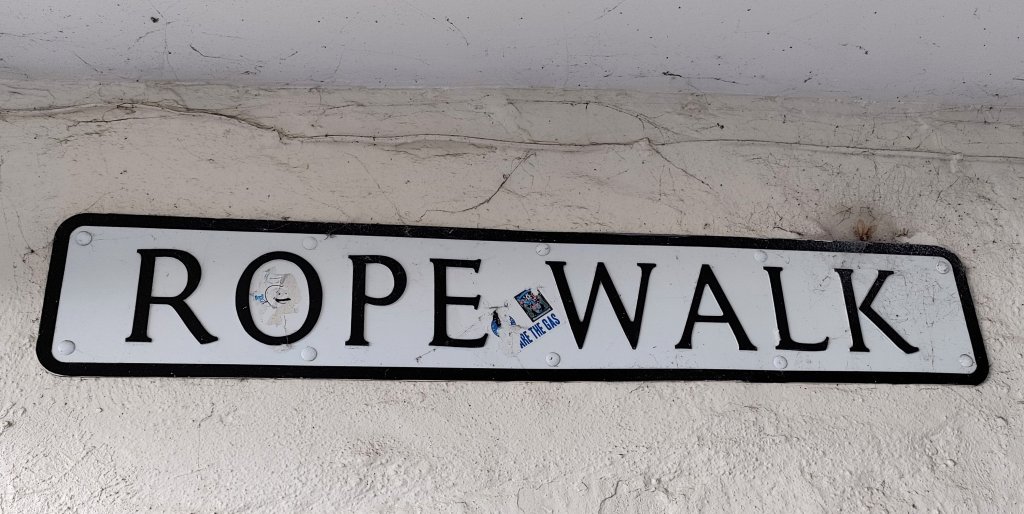
I took this photograph in a small town in the Cotswolds in the UK. The sign sits high up on a wall that lines one side of a small road that provides an escape from the main high street. The entrance is enclosed on both sides and above by squat old buildings made from Cotswold stone, and the alleyway winds away from the shops through a mysterious series of corridors until you find yourself at the back of the town in the car park.
In the UK many of the street names in old towns and villages had quite literal names. There are a lot of Station Roads that now, or used to, lead to train stations. When I saw this sign I could not imagine how it got it’s name and some google adventures later I still do not know.
The local area used to be famous for it’s cloth trade, and there were many woollen mills in the district from as far back as the thirteenth century. I couldn’t find confirmation that this particular Rope Walk relates to that activity, although the connection seems sensible.
How do you think Rope Walk got its name?
What kind of mysterious things may have happened there?
I’m not a huge fan of creative exercises, so it’s not my habit to tell people what to do with these prompts. There are lots of options – a scene, some flash fiction, a short story, an idea for a short film or a physical piece of art. If you do have a go with this one and would like to drop the result in the comments please do so. I would be very interested to see what people make of these so please do link to blog posts or comment below.
Thank you for reading. I also write, make art and films. You can read my short fantasy stories here on Simily. If you like these prompts and want to get a copy of a free short book of them I wrote, and to hear more about my writing projects please join my mailing list here. You can see my films at my YouTube channel here. You can see things with my designs on at my shop here. Could even treat yourself if you wanted to. Just saying. If buying art is not your thing, but you would like to support what you see I also have a Patreon Page.
One-Time
Monthly
Yearly
Like my work but none of the above options appeal? You could consider a one off donation instead. I would really appreciate it.




 The Magpie at Midnight