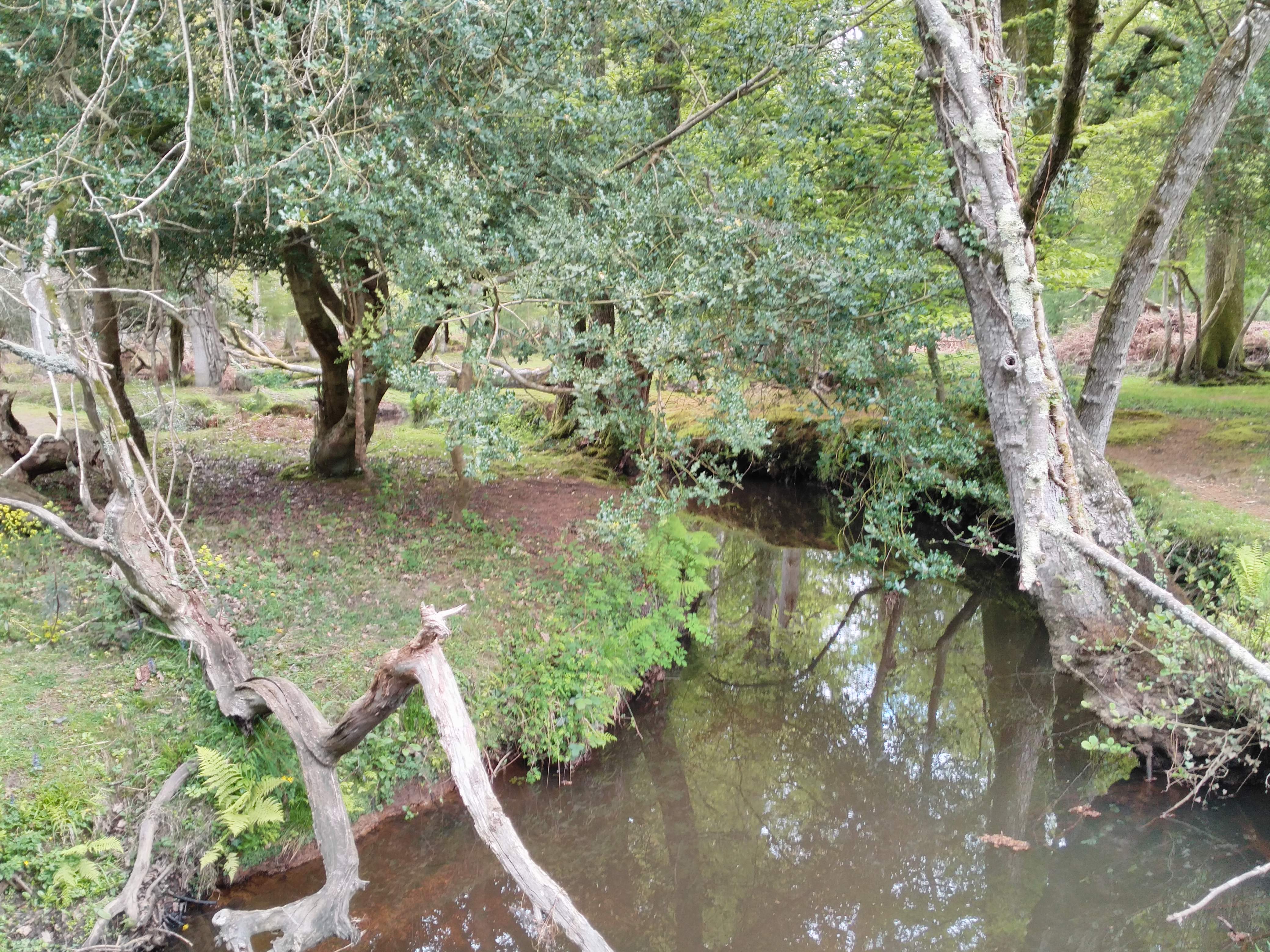
Walking in the woods.

We are taking a few days down time at the moment, staying in the New Forest. It is a very beautiful, wild place. We have taken several long walks through the woods and I have certainly felt better for it. The air is lighter and fresher here. At times I feel I walk a little taller, the muscles in my back are not so tense.

When I manage to get out of the city and into the countryside I am frequently shocked into remembering how vividly beautiful the UK countryside is. It is spring at the moment and we have encountered blubell carpets and the fresh green shoots of new growth all around us. I often feel, when out and about in our vibrant green spaces, that many people from the UK who travel long distances to find exotic wild locations are missing out on the wild places that are much closer to home. 

But we have also encountered patches of land where the trees are dying. The forest is undergoing wetter winters and dryer summers, and the natural soil microcosm is becoming unbalanced, leading to the roots of many trees rotting in the soil. The change in soil conditions is probably an consequence of climate change. 

Here is another reason I am so disappointed with the moral leadership of our current generation of politicians. We have known for quite some time there is much work to be done to protect our beautiful wild places, from cleaning up polution, and carefully assessing the impact of various pesticides on the soil, through to the Enormous task of planning and taking action over climate change. But while there are many organisations working hard to tackle these problems, our politicians appear to take a ‘profit now, some one else can clean up the mess later’ attitude. This is a peculiarly selfish and short sighted approach, which burdens generations to come with a vastly depleted natural environment, and the loss of those wonderful British wild places.

Easter in the UK – what our ‘Christian country’ could looks like


It is Easter in the UK. I am away from home for the weekend and will be walking on the South Downs later. At the moment I am sipping coffee and nursing a hangover. I really love the spring in Britain. Our countryside is green, and lush, and full of delicate blossom and the tender petals of bulbs that flourish early in the year. 

I am not religious, but I guess I have been reflecting this Easter on the state of things here in the UK. I went to a Church of England school when I was young, and learned many of the stories that form the basis of the Christian teachings. I was particularly struck by many of these stories, and as an adult am still taken with the elegance with which some of these stories convey quiet but clear messages about compassion, and empathy, and understanding. In the Good Samaritan it is not the men with the status of religious authority who come to the aid of a man who has been robbed and left beaten by the road, but a relatively modest outsider, the Samaritan who is from a different, despised tribe and a different place. I do not remember the story in which Jesus spent his time enjoying the pleasures of schmoozing with rich bankers, but I do remember the stories in which he tended to the sick, and gave comfort to those in need, or those who society would have cast aside.

I bring this up because last week our prime minister found time to make a fuss about the packaging on some chocolate eggs, which did not have the word Easter on them, and she felt it important to speak out as a ‘vicar’s daughter’. Yet she presides over a government that seems very comfortable with directly attacking the living standards of people living with long term illness and disability, and with pushing families with young children over the poverty line. Food banks have become commonplace in this country once more. I bring this up because in the last 12 months every time I have heard someone use the phrase ‘this is a Christian country’ it has some how been linked to a statement about turning away refugees from war torn countries. It has been used to justify some in saying that there is simply no room in this inn for 3000 children who have been separated from their parents during the trauma of their flight from war and termoil. I bring this up because we seem to think that protecting wellbeing of the corporate businesses and banks is more important than protecting the workplace rights of ordinary working people. We have become intensely relaxed about giving the money lenders the keys to the temple.

Now my recollections of many of the Christian teachings of my childhood is a bit hazy, so maybe I don’t remember those bits where Jesus spoke of how fine it was to take money from disabled people, or deny shelter to people in need of it. Maybe it’s just my own personal biases that draw me to focus on the bits where he spoke about compassion and about treating others as we may wish to be treated ourselves.

At this time of rebirth and renewal maybe it is a good idea to re-visit what we mean when we say ‘this is a Christian country’. Jesus was a champion of the poor, and the sick, and the different. Perhaps this would be a good time to have a think about what a ‘Christian country’ that took his vision seriously would look like.

Back at Battersea: Being in the audience

IMG_1313

The beautiful tiled floor at Battersea Arts Centre

We were back a Battersea Arts Centre again last night to see the the verbatim play E15. E15 is a verbatim play made by the theatre company Lung. This is the third production I have seen by them, after The 56, and Chilcot. All three were great, really worth seeing. Their productions are written on the basis of interviews with people affected by real life situations. I’ve been impressed by how sensitively they deal with stories about difficult and traumatic events.

E15 is the story of 29 single mothers who were served eviction notices from their council accommodation and their subsequent partly successful protests against the council in new ham. It was an emotionally raw and moving play – I recommend any one who can see it should see it. Last week I blogged about who it is important of truth when telling stories about real people, especially when those people are frequently denied a voice. Last night I was thinking about the importance of being on the other side of that equation. For someone to tell stories it also requires there to be someone who will listen.

The likelihood of more plays like E15 getting funding and being made widely available is dependent on there being a demand for them. Over the last two weekends I’ve seen two great plays about ‘working class Britain’. These are stories that don’t often get told in the mainstream media outside of the lazy stereotypes the swirl around people on benefits.  It is easy to get stuck in going back to the same kinds of stories over and over for entertainment. It is easy to ignore those stories that fall outside of that. Especially in the UK at the moment, there is a great need for us to widen our horizons and start listening to the stories of people who have quite a different experience of being human than we do.


Mark Thomas, The Red Shed, Telling Stories and Emotional Truth

IMG_20170311_143730

Yesterday we went to see The Red Shed by Mark Thomas as Battersea Arts Centre. We go there on a fairly regular basis. We’ve only started going since a fire consumed the roof of their great hall. They are currently undergoing a painstaking restoration of the great hall, and each time we go it seems there is a little more progress, a little more of the building revealed, which in itself is quite exciting. Because of the fire, we have always seen shows in the much smaller council chamber upstairs, which is small and intimate, and possibly my favourite place to see new writing in London.

Yesterday we were seated right in the front row and so were less then five meters from Mark Thomas as he performed The Red Shed. I loved it. You should see it. I’ll say that upfront. He delivered the story of his relationship with a building known as ‘The Red Shed’, a socialist club in Wakefield. He drew on his own personal history of activism to tell the story of the Red Shed and the people who go there. A winding narrative that took a tour through his activism during miners strike in the North of England. Effectively, he gave a one man performance, but he also bought 6 members of the audience to sit on stage and had them hold up a series faces made of board to invoke different characters through the show. I really like this very stripped down form of storytelling, where the narrative is allowed to do most of the work.

Through out the piece he spoke about the importance of stories. That stories are important in allowing us to remember our history, and so understand who we are. The stories that are told about us can come to define who we are, we may come to live within those stories and that they may come to direct what we do in the future. For this reason it important that the stories we tell about people are true. He made an important point about how the stories about the working class in Britain are frequently told badly or incorrectly, over simplistically, or simply not told at all. Politically this has had great and damaging impact on the working class in the UK. The realities of their lives, their needs and anxieties have been ignored, lost, misunderstood and ultimately somehow seen as irrelevant by many of us. By failing to make space for these stories, and by failing to recognise them as important, we have failed understand, and have failed to see the people and communities behind them as important.

After the show he was in the foyer signing books and I wanted to speak with him but couldn’t quite arrange my thoughts to do so. I was quite upset coming out of the performance. Much of of what he said resonated strongly with me and I wish I could sit and talk with him about this. Some of the documentary and playwriting work I am trying to do is around mental health and disability. These are complicated stories that are frequently seen in the news in only their most simplistic and ‘tragic’ form. My starting point now I think is to try to work with the people whose story I am interested in, so that we tell the story together, rather than have me tell their story for them. I’m not quite sure how I’ll pull this off, yet.

Stories have an emotional truth. We believe or don’t believe them based on whether we feel they are true, so if something feels true it is easy to slip a few lies through with that feeling. In fact it is possible to cynically slip through a lot of lies if you can attach them to an existing feeling, which can have awful consequences. A lot of the racist propaganda emerging from the leave campaign for Brexit last year did just this, and now we have racist hate crimes on the rise. This is why it is important when tell stories about real people, that we make sure what is in those stories is true.